Power interruptions are not a minor inconvenience for people who rely on CPAP therapy. A CPAP machine is designed to deliver continuous airflow during sleep, and any disruption in power directly interferes with treatment. When backup power is poorly planned or unsafe, the risks extend beyond discomfort into real health and safety concerns.
These CPAP power station safety guidelines are written to help users understand what can go wrong, why it happens, and how to reduce risk when using a portable power station as a backup power source. This is not a product review and not sales advice. The focus is safety, reliability, and realistic use during power outages.
Why CPAP Power Station Safety Matters
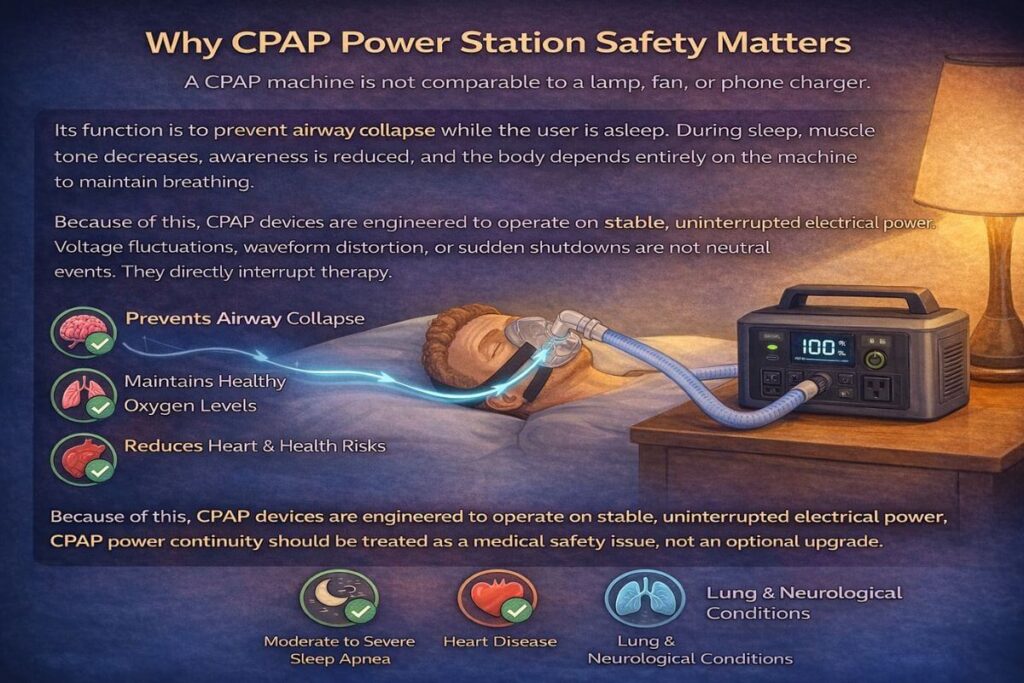
A CPAP machine is not comparable to a lamp, fan, or phone charger. Its function is to prevent airway collapse while the user is asleep. During sleep, muscle tone decreases, awareness is reduced, and the body depends entirely on the machine to maintain breathing.
Because of this, CPAP devices are engineered to operate on stable, uninterrupted electrical power. Voltage fluctuations, waveform distortion, or sudden shutdowns are not neutral events. They directly interrupt therapy.
For users with moderate to severe sleep apnea, heart disease, lung conditions, or neurological disorders, CPAP power continuity should be treated as a medical safety issue, not an optional upgrade.
What Happens If a CPAP Loses Power During Sleep
Understanding the real sequence of events during a power loss helps explain why backup planning is important.
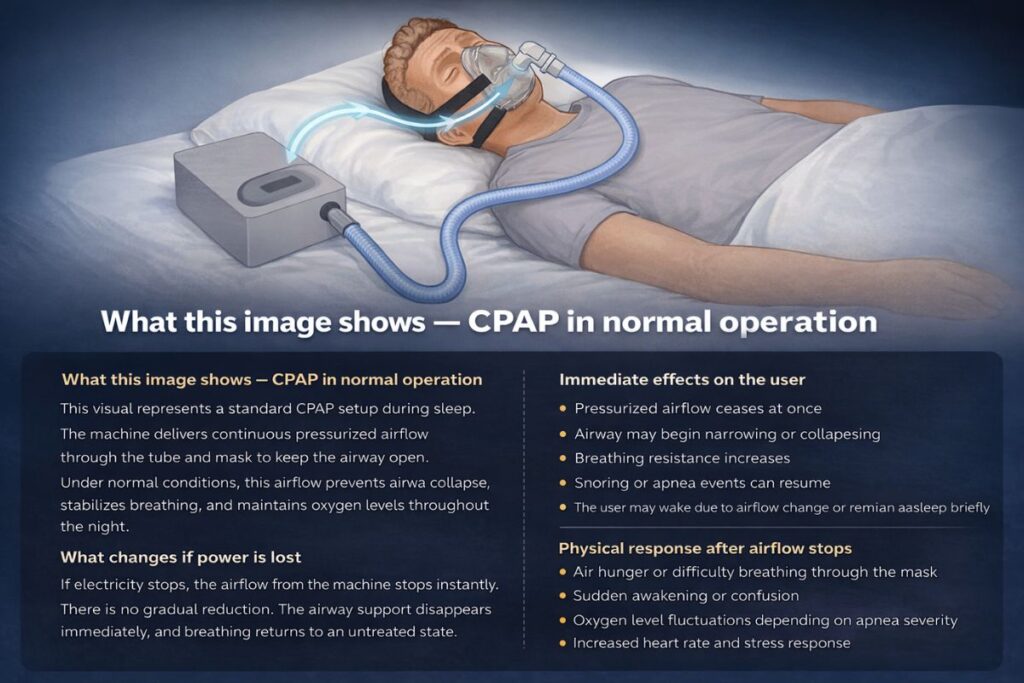
When power is interrupted, airflow stops immediately. There is no gradual reduction. The response varies from person to person:
- Some users wake quickly due to airflow changes or mask pressure shifts
- Others remain asleep for several seconds or longer, depending on sleep depth
- Auto-adjusting machines have no fallback mode without power
For many users, waking up involves confusion, a sensation of air hunger, or panic. While most masks allow passive exhalation, breathing without pressurized airflow can feel unfamiliar and distressing.
Health Risks by Apnea Severity
The impact of power loss is not the same for everyone:
- Mild sleep apnea: Often results in disrupted sleep and discomfort
- Moderate sleep apnea: Apneas resume quickly, increasing oxygen drops and stress response
- Severe sleep apnea: Oxygen desaturation can occur rapidly, especially during REM sleep
People with severe apnea, cardiac arrhythmias, prior stroke, or chronic lung disease should consider overnight CPAP power loss a higher-risk scenario.
Why Waking Up Isn’t Always Immediate
It is a misconception that loss of airflow always wakes the user instantly. Factors that delay awareness include:
- Deep sleep stages
- Alcohol consumption
- Sleep medications
- Neurological or cognitive conditions
Delayed awakening increases the duration of untreated apnea events. Sudden awakening can also cause dizziness or disorientation, especially when trying to troubleshoot power in the dark.
Understanding CPAP Power Requirements Before Using a Power Station
Safe backup planning starts with knowing how CPAP machines actually consume power.
Typical CPAP Power Consumption
Most CPAP machines draw relatively modest power during steady operation. However, actual consumption depends on several variables:
- Pressure settings
- Therapy mode (CPAP, APAP, BiPAP)
- Heated humidifier use
- Heated tubing
Humidification and tubing heat can significantly increase power draw and shorten backup runtime.
Why Published Wattage Numbers Can Be Misleading
Manufacturer specifications are often measured under controlled conditions. Real-world use differs due to:
- Ambient temperature
- Mask leaks
- Pressure variability
- Aging components
Relying only on published wattage numbers without testing real usage can lead to insufficient backup capacity during an outage.
Critical CPAP Power Station Safety Guidelines
This section addresses the most common and serious safety issues seen in CPAP backup setups.
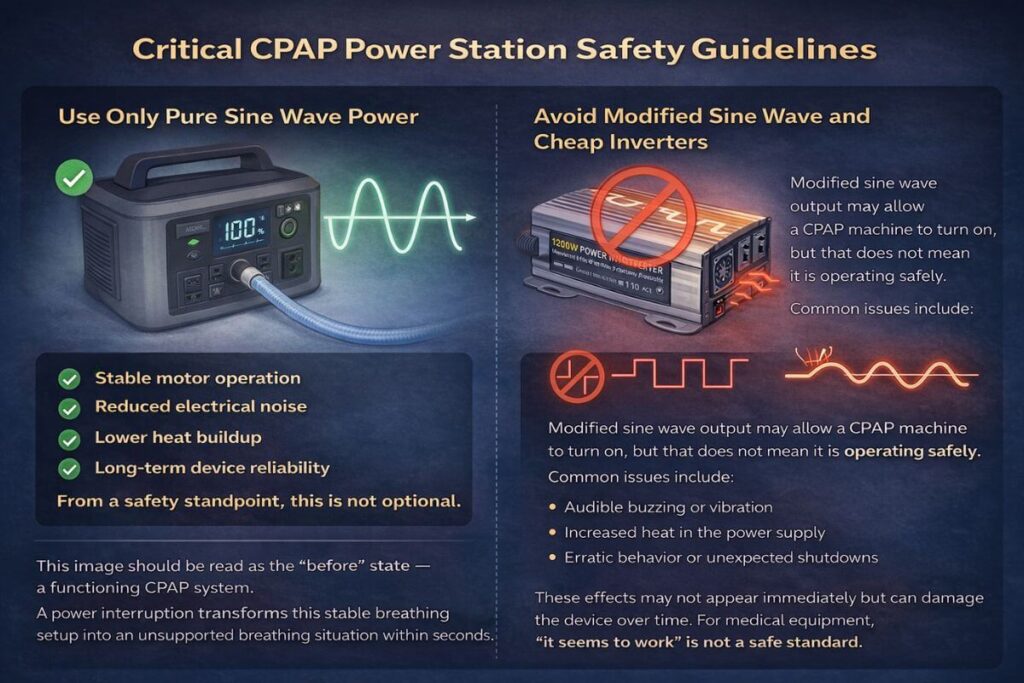
Use Only Pure Sine Wave Power
CPAP machines contain sensitive electronics and motor controllers designed for clean AC power. A portable power station used for CPAP must provide pure sine wave output.
Pure sine wave power helps ensure:
- Stable motor operation
- Reduced electrical noise
- Lower heat buildup
- Long-term device reliability
From a safety standpoint, this is not optional.
Avoid Modified Sine Wave and Cheap Inverters
Modified sine wave output may allow a CPAP machine to turn on, but that does not mean it is operating safely. Common issues include:
- Audible buzzing or vibration
- Increased heat in the power supply
- Erratic behavior or unexpected shutdowns
These effects may not appear immediately but can damage the device over time. For medical equipment, “it seems to work” is not a safe standard.
CPAP Humidifier Power Safety Considerations
Heated humidifiers increase comfort but also increase electrical risk.
Key points to understand:
- Humidifiers significantly increase power draw
- Poor power quality can cause overheating
- Water and electricity are in close proximity
During outages, many users reduce or disable humidification to improve safety and extend runtime. While comfort may decrease, electrical stability often improves.
Users with chronic nasal issues should weigh comfort against safety and consult their healthcare provider if unsure.
Safe and Unsafe Power Sources for CPAP Machines
Not all backup power options are suitable for overnight CPAP use.
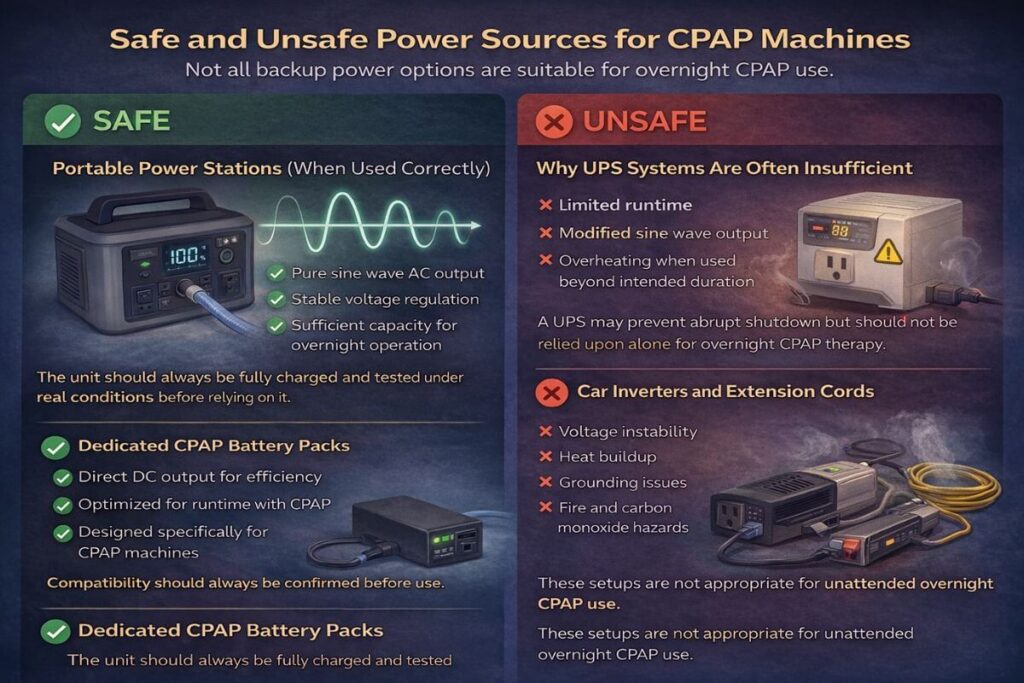
Portable Power Stations (When Used Correctly)
A portable power station can be safe for CPAP use if it provides:
- Pure sine wave AC output
- Stable voltage regulation
- Sufficient capacity for overnight operation
- Adequate ventilation
The unit should always be fully charged and tested under real conditions before relying on it.
Dedicated CPAP Battery Packs
Battery packs designed specifically for CPAP use often provide direct DC output, reducing conversion losses. They are typically optimized for runtime but may have limited flexibility or humidifier support.
Compatibility should always be confirmed before use.
Why UPS Systems Are Often Insufficient
Uninterruptible Power Supplies are designed for short-term bridging, not sustained overnight medical operation. Limitations include:
- Limited runtime
- Modified sine wave output
- Overheating when used beyond intended duration
A UPS may prevent abrupt shutdown but should not be relied upon alone for overnight CPAP therapy.
Car Inverters and Extension Cords
Vehicle inverters and long extension cords introduce multiple risks:
- Voltage instability
- Heat buildup
- Grounding issues
- Fire and carbon monoxide hazards
These setups are not appropriate for unattended overnight CPAP use.
Preparing Your CPAP Setup Before a Power Outage
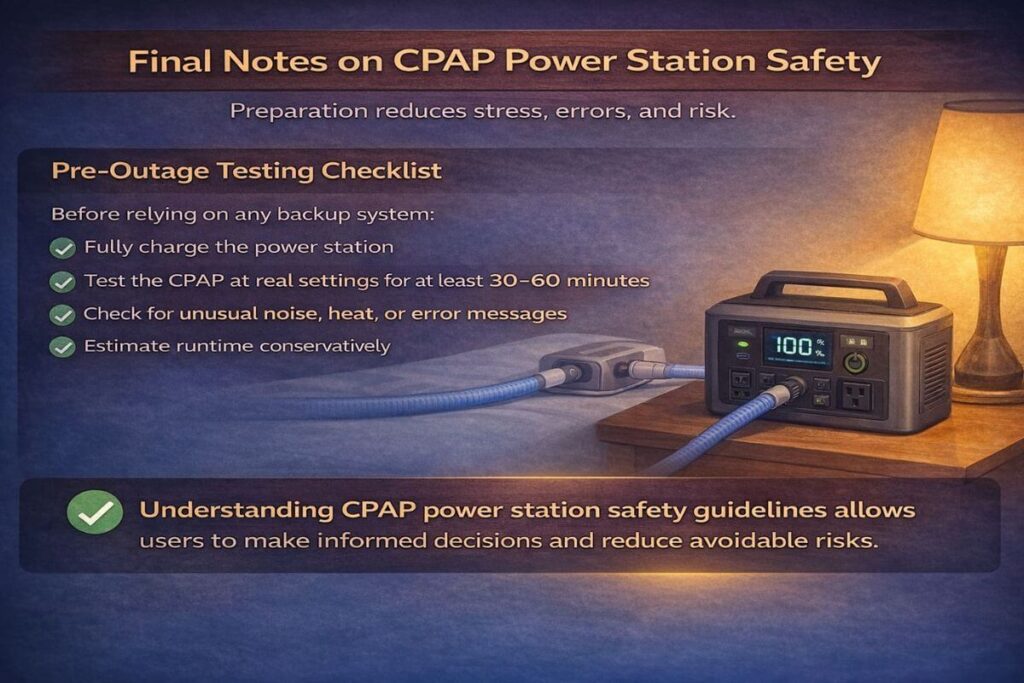
Preparation reduces stress, errors, and risk.
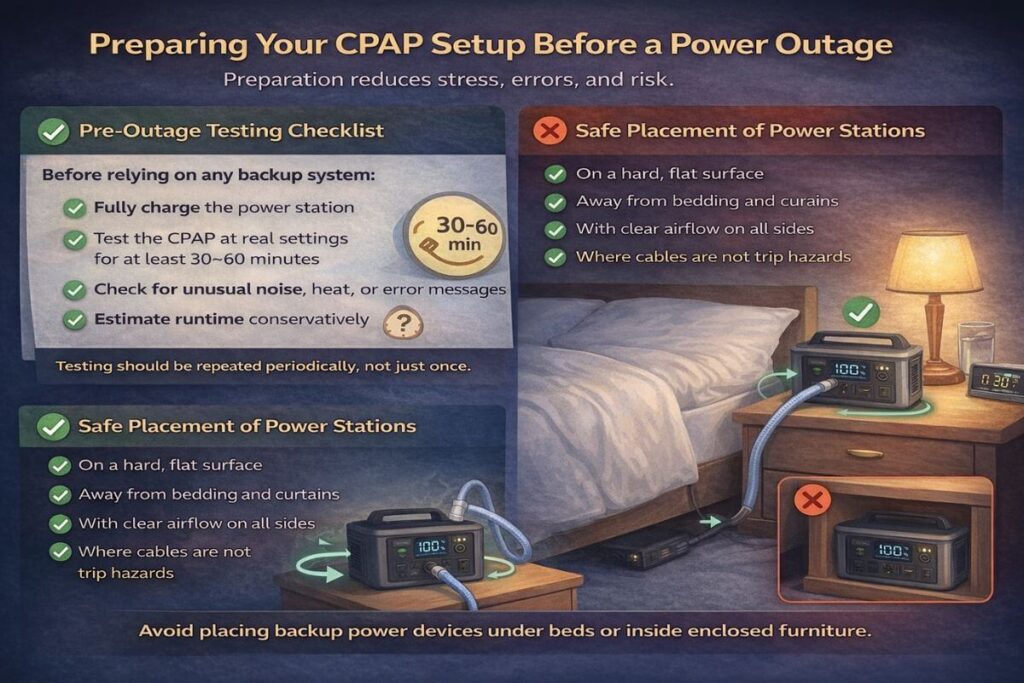
Pre-Outage Testing Checklist
Before relying on any backup system:
- Fully charge the power station
- Test the CPAP at real settings for at least 30–60 minutes
- Check for unusual noise, heat, or error messages
- Estimate runtime conservatively
Testing should be repeated periodically, not just once.
Safe Placement of Power Stations
Power stations should be placed:
- On a hard, flat surface
- Away from bedding and curtains
- With clear airflow on all sides
- Where cables are not trip hazards
Avoid placing backup power devices under beds or inside enclosed furniture.
Common CPAP Backup Power Mistakes
Many problems occur due to incorrect assumptions rather than lack of equipment.
Underestimating Runtime Needs
Planning for a few hours instead of a full night often results in power loss during early morning sleep cycles, when awareness may be lowest.
Ignoring Power Quality
Battery capacity alone does not guarantee safety. Clean, stable power is essential for medical electronics.
Using Untested Equipment
The first use of backup power should never be during an actual outage. Discovering incompatibility at 2 a.m. is a safety risk.
When a Larger CPAP Backup Power Solution Is Needed
Backup requirements vary based on lifestyle and outage patterns.
- Frequent outages may require higher-capacity solutions
- Multi-day outages require recharging strategies and reduced power use
- Travel, camping, and disaster scenarios introduce additional risks
Each scenario should be evaluated separately, with conservative assumptions.
Frequently Asked Questions About CPAP Power Station Safety
Is it safe to run a CPAP without a humidifier?
For many users, yes, especially short-term. Comfort may decrease, but safety and runtime often improve.
Can solar panels power a CPAP machine safely?
Solar panels can recharge batteries or power stations, but direct operation requires stable regulation and sufficient storage.
How long can a CPAP run on a portable power station?
Runtime depends on battery capacity, power draw, and settings. Testing under real conditions is the only reliable method.
Is a UPS enough for overnight CPAP use?
In most cases, no. UPS systems are not designed for sustained overnight medical operation.
Final Notes on CPAP Power Station Safety Guidelines
CPAP therapy depends on consistency and reliability. Backup power planning is not about convenience. It is about ensuring therapy continues safely when normal power is unavailable. Understanding CPAP power station safety guidelines allows users to make informed decisions and reduce avoidable risks.