CPAP Power Backup Mistakes to Avoid During Power Outages

CPAP Power Backup Mistakes

CPAP power backup mistakes can turn a simple power outage into a dangerous, sleep-disrupting emergency. Many CPAP users assume their therapy is protected—until the lights go out at 2 a.m. and the machine shuts off. The sudden silence, the struggle to breathe comfortably, and the rising panic can feel overwhelming. The problem isn’t just losing electricity. It’s poor preparation. The solution? Understanding exactly which It to avoid—and building a safe, reliable backup strategy before the next outage hits.

This guide walks you through the most common CPAP power backup mistakes, why they happen, and how to prevent them using practical, safety-first planning.

Why CPAP Power Backup Mistakes Can Be Dangerous

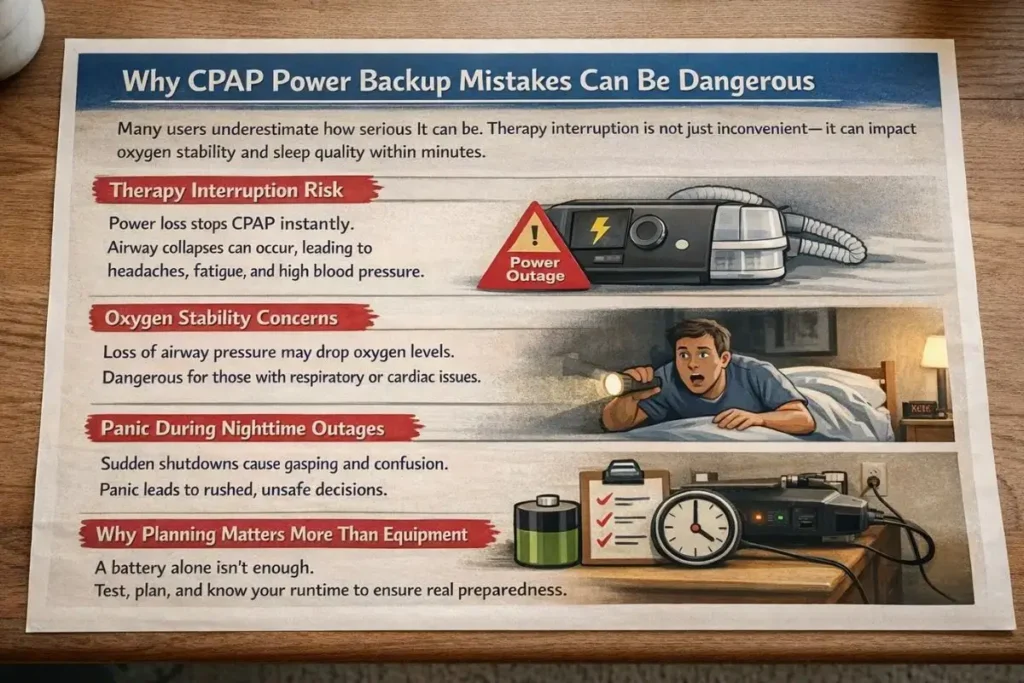
Many users underestimate how serious It can be. Therapy interruption is not just inconvenient—it can impact oxygen stability and sleep quality within minutes.

Therapy Interruption Risk

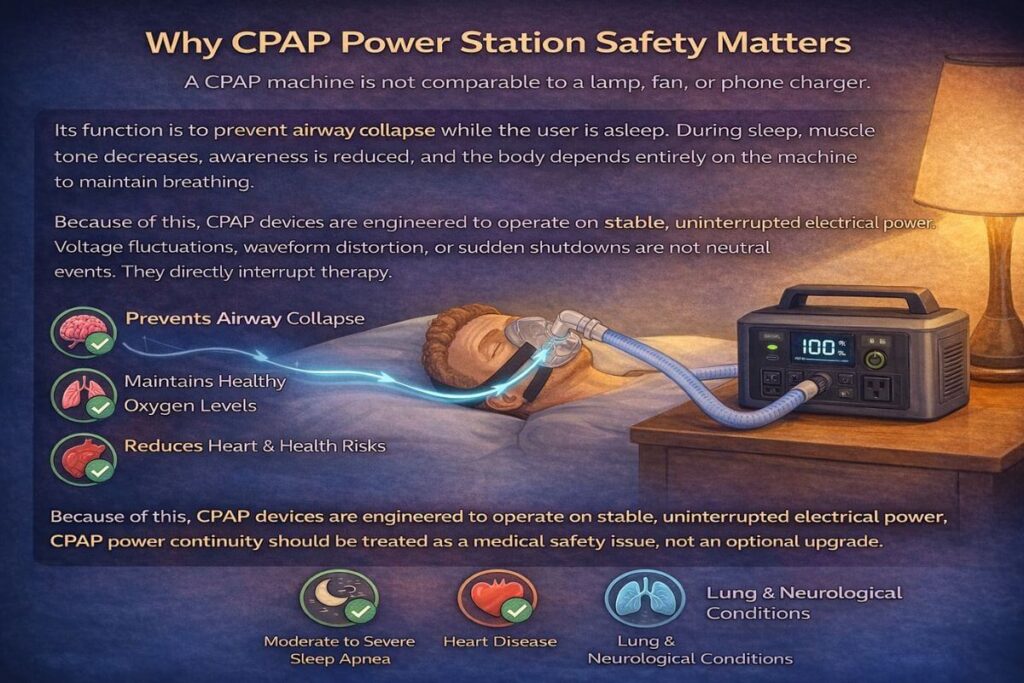
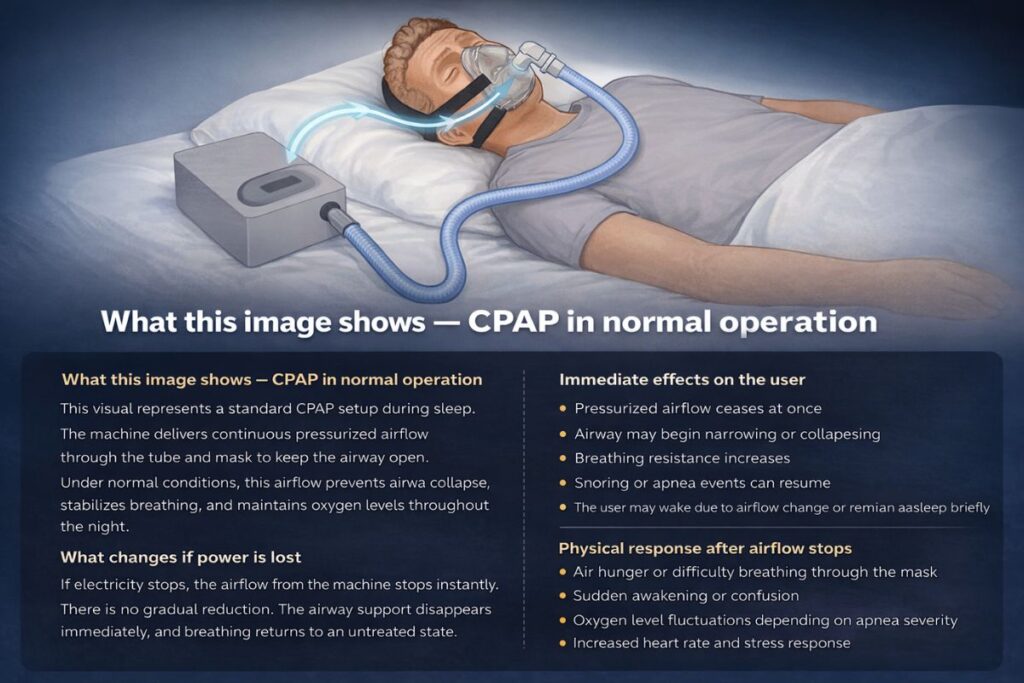
When power fails, CPAP therapy stops instantly unless backup power activates. For users with moderate to severe obstructive sleep apnea, this can mean repeated airway collapse throughout the night. Even one untreated night may cause morning headaches, daytime fatigue, or elevated blood pressure.

Oxygen Stability Concerns

If you rely on consistent airway pressure, losing power may cause drops in oxygen saturation. Some users with coexisting respiratory or cardiac conditions are at higher risk. It often ignore this physiological impact.

Panic During Nighttime Outages

Unexpected shutdowns trigger anxiety. Many users report waking up gasping or confused in darkness. Panic leads to rushed decisions—another reason It become dangerous.

Why Planning Matters More Than Equipment

Owning a battery isn’t the same as being prepared. The biggest CPAP power backup mistakes stem from assuming equipment alone equals safety. Planning, testing, and understanding runtime matter far more than brand names.
Why CPAP Power Backup Mistakes Can Be Dangerous

CPAP Power Outage Safety Tips Most Users Ignore

cpap power outage safety tips

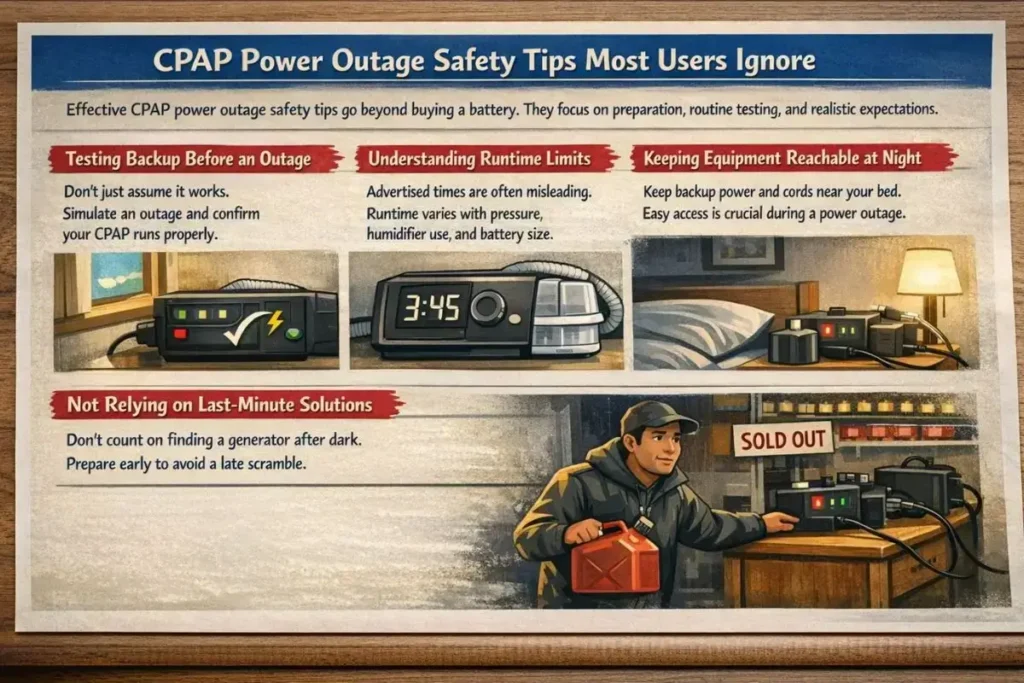
Effective cpap power outage safety tips go beyond buying a battery. They focus on preparation, routine testing, and realistic expectations.

Testing Backup Before an Outage

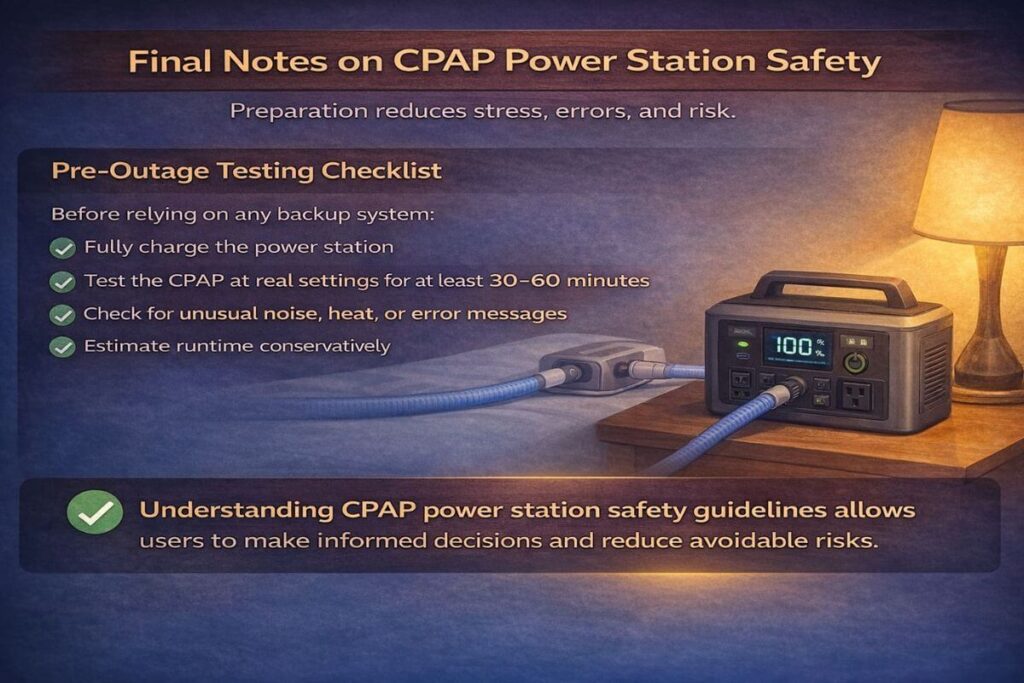
One of the most common mistakes It is never testing the battery under real conditions. Users plug it in once and assume it works. Instead, simulate an outage during the day and confirm your CPAP runs properly.

Understanding Runtime Limits

Manufacturers often advertise ideal runtimes. Real-world runtime depends on pressure settings, humidifier usage, and battery capacity. Ignoring these variables leads to dangerous It.

Keeping Equipment Reachable at Night

During an outage, you should not be searching for cables in the dark. Place your battery and cords within arm’s reach. Simple positioning prevents avoidable It during emergencies.

Not Relying on Last-Minute Solutions

Generators from neighbors or rushing to buy a battery after storm warnings is risky. It often occur when preparation starts too late.

CPAP Battery Backup Mistakes That Reduce Runtime

cpap battery backup mistakes

Many cpap battery backup mistakes revolve around poor calculations and unrealistic assumptions.

Buying an Undersized Battery

A small battery may power a CPAP for only a few hours. Users frequently underestimate watt-hours needed for a full night. This is one of the most frequent CPAP power backup mistakes.

Ignoring Humidifier Load

Humidifiers dramatically increase power consumption. Leaving it on high while running on battery can cut runtime in half. Many cpap battery backup mistakes happen because users forget to disable heated humidity during outages.

Not Calculating Full-Night Usage

If you sleep 8 hours, your backup must support at least that duration—plus a safety buffer. CPAP power backup mistakes occur when users plan for “average” instead of personal usage patterns.

Assuming Manufacturer Runtime

Marketing claims often assume low pressure and no humidifier. Real-world conditions differ. Trusting advertised numbers blindly is one of the most overlooked CPAP power backup mistakes.
CPAP Battery Backup Mistakes

Portable Power Station CPAP Mistakes

portable power station cpap mistakes

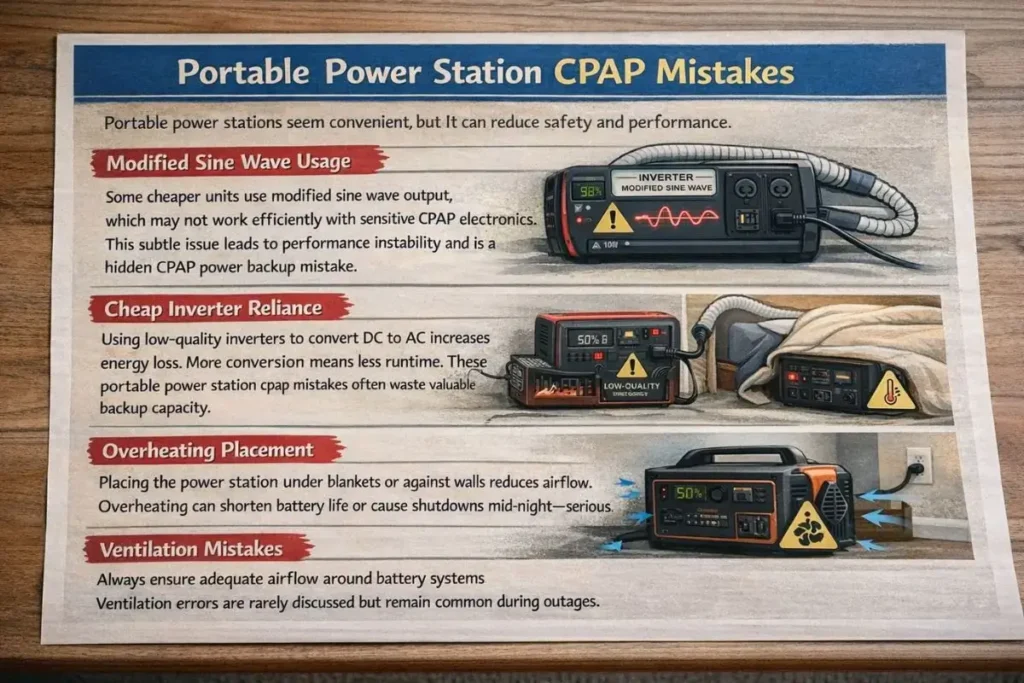
Portable power stations seem convenient, but It can reduce safety and performance.

Modified Sine Wave Usage

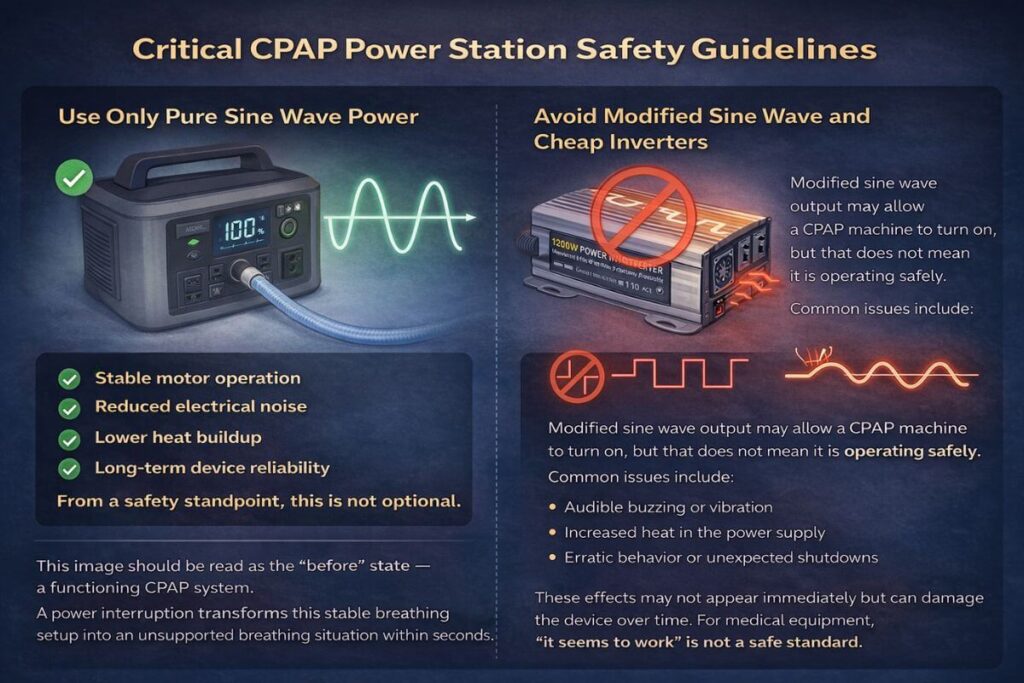
Some cheaper units use modified sine wave output, which may not work efficiently with sensitive CPAP electronics. This subtle issue leads to performance instability and is a hidden CPAP power backup mistake.

Cheap Inverter Reliance

Using low-quality inverters to convert DC to AC increases energy loss. More conversion means less runtime. These portable power station cpap mistakes often waste valuable backup capacity.

Overheating Placement

Placing the power station under blankets or against walls reduces airflow. Overheating can shorten battery life or cause shutdowns mid-night—serious It.

Ventilation Mistakes

Always ensure adequate airflow around battery systems. Ventilation errors are rarely discussed but remain common It during outages.
Portable Power Station CPAP Mistakes

CPAP Emergency Power Planning Errors

cpap emergency power planning

Strong It prevents last-minute chaos, medical risk, and avoidable CPAP power backup mistakes. Many users think owning a battery equals preparedness. It doesn’t. True planning means testing, maintaining, and thinking beyond a single night scenario. Most CPAP power backup mistakes happen not because people lack equipment—but because they lack a structured system.

No Backup Testing

One of the most common It is assuming your backup will work simply because it powered on once. Batteries degrade. Cables loosen. Settings change. Firmware updates happen. Pressure levels increase over time.

If you do not test your full setup—machine, battery, cables, humidifier settings—under real-world conditions, you are gambling with your therapy. A proper test means:

  • Disconnecting main power completely
  • Running your CPAP for at least 1–2 hours on battery
  • Monitoring noise, stability, and overheating
  • Checking remaining battery percentage afterward

Quarterly testing ensures you catch failures before they catch you at 2 a.m. During severe weather seasons, testing monthly is even safer. Preventing It starts with controlled simulations, not assumptions.

No Charging Routine

Batteries left partially charged for long periods slowly lose capacity. Lithium batteries may appear “full,” but internal degradation reduces real runtime. This silent decline is one of the most overlooked CPAP power backup mistakes.

A simple solution is to create a charging calendar:

  • Recharge after every test
  • Top up monthly even if unused
  • Store batteries at manufacturer-recommended charge levels
  • Avoid extreme heat or freezing storage conditions

When outages happen, you don’t want uncertainty about your charge status. It often begin with, “I thought it was charged.”

Single-Source Dependency

Relying on only one battery system is risky in areas prone to storms, hurricanes, or winter grid failures. Multi-night outages are increasingly common. If your only battery fails, you have no safety net.

Effective cpap emergency power planning considers layered protection:

  • Primary battery system
  • Secondary charging option (vehicle, generator, or solar input)
  • Backup location if home power is out long-term

Single-source dependency is one of the most dangerous CPAP power backup mistakes because it creates a false sense of security.

No Contingency Planning

Ask yourself:

  • What if the outage lasts 48–72 hours?
  • What if you are traveling?
  • What if roads are blocked during a storm?
  • What if your battery fails mid-night?

It often stem from narrow thinking—planning only for “short” outages. Real cpap emergency power planning accounts for worst-case scenarios, not best-case assumptions.
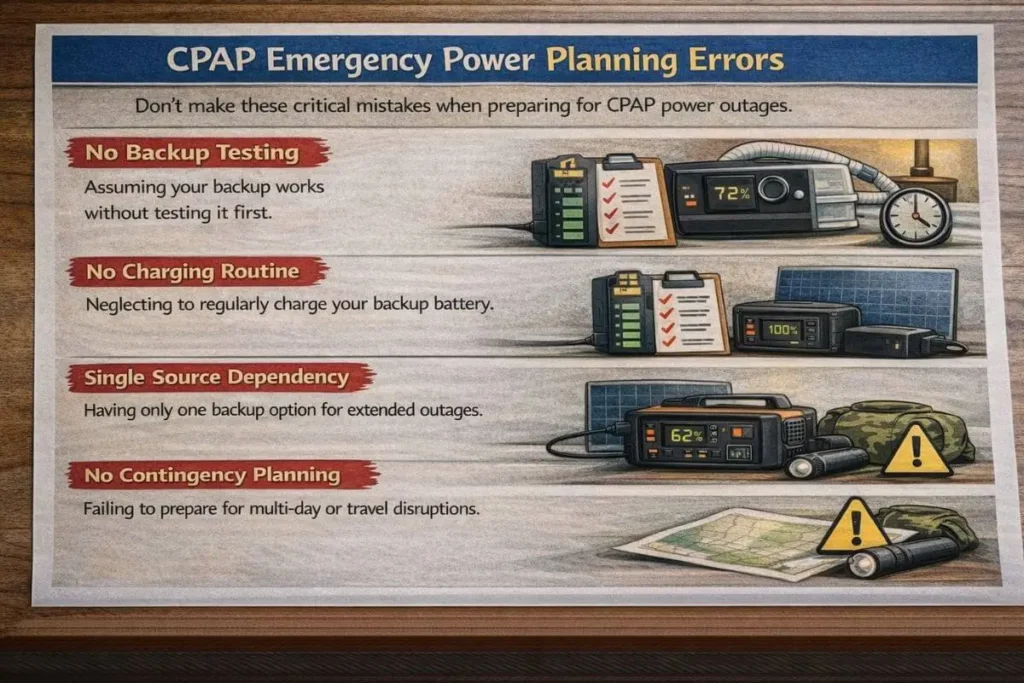
CPAP Emergency Power Planning Errors

Mistakes During Active Power Outages

Even well-prepared users can make It once the outage begins. Darkness, stress, and sudden silence from your machine can trigger rushed decisions.

Panic Reactions

When CPAP airflow stops suddenly, many users wake up disoriented. Heart rate increases. Breathing feels unstable. Panic sets in. Panic leads to poor decisions—grabbing the wrong cable, unplugging adapters, or mishandling batteries.

The key is muscle memory. If you’ve tested your setup before, you will know exactly what to do. Calm execution prevents avoidable CPAP power backup mistakes during real emergencies.

Unplugging Wrong Cables

In low light, cables look similar. Disconnecting the wrong adapter may:

  • Reset device settings
  • Damage connectors
  • Interrupt battery activation
  • Waste precious time

Labeling cords clearly and organizing them reduces this risk dramatically. Small preparation eliminates large CPAP power backup mistakes.

Unsafe Battery Placement

During outages, users sometimes move batteries onto beds, carpets, or near water sources. This is dangerous. Batteries generate heat and need stable placement.

Best practice:

  • Place on a flat, hard surface
  • Ensure proper ventilation
  • Keep away from moisture
  • Avoid covering with blankets

Unsafe placement is one of the more physically hazardous of It.

Using Extension Cords Incorrectly

Overloaded or thin extension cords can overheat, especially when powering high-draw devices like CPAP units with humidifiers. During storms, damaged wiring increases fire risk.

If extension cords are unavoidable:

  • Use heavy-duty rated cords
  • Avoid daisy-chaining multiple cords
  • Keep cords fully uncoiled
  • Inspect for damage regularly

Electrical safety is part of avoiding It—not separate from it.
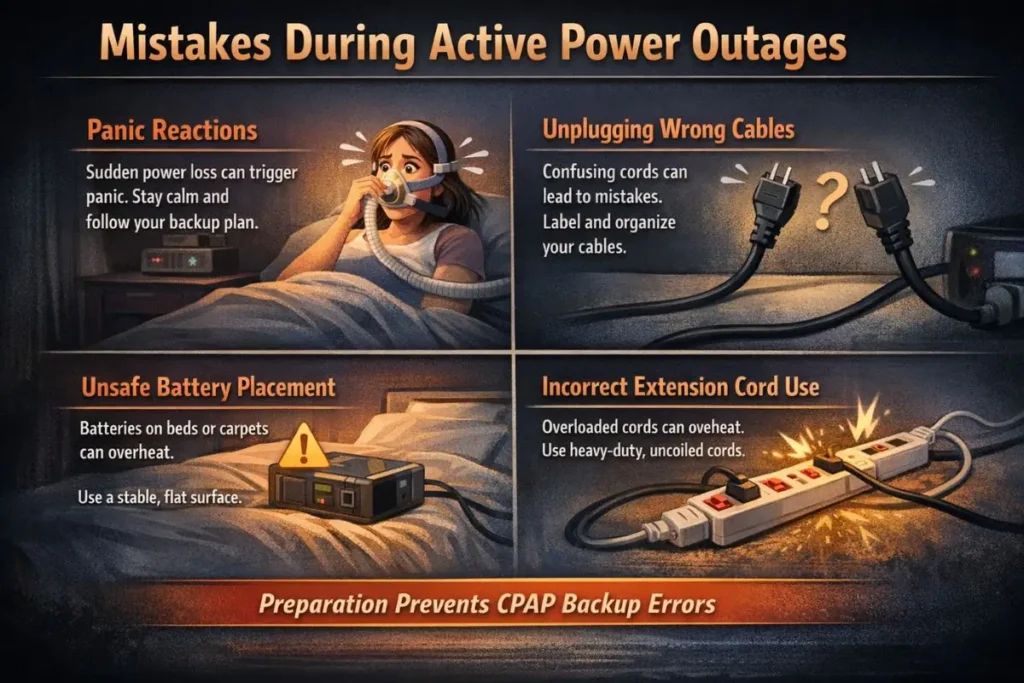
Mistakes During Active Power Outages

Safety Mistakes With CPAP Humidifiers

Humidifiers improve comfort but dramatically increase energy demand. Many CPAP power backup mistakes are directly tied to heated humidifier use during battery operation.

Leaving Humidifier on High During Battery Use

Heated humidification can double or even triple power consumption. On battery, this significantly reduces runtime. Some users unknowingly drain their battery halfway through the night because humidity settings were left unchanged.

During outages:

  • Turn off heated humidity
  • Use passive humidity if available
  • Consider lowering tube heat

This simple adjustment prevents some of the most expensive CPAP power backup mistakes.

Not Understanding Power Draw

Many users never calculate actual watt-hour usage. CPAP pressure settings, heated tubing, and humidity all contribute to consumption. Without understanding power draw, it is impossible to plan realistically.

Knowledge eliminates uncertainty—and prevents It driven by misinformation.

Overheating Risks

Continuous heating from humidifiers increases strain on batteries and inverters. Overheating can cause automatic shutdown, cutting therapy mid-night.

Monitoring ventilation and reducing load protects both your battery and your safety.

Medical Risk Mistakes Users Make

CPAP power backup mistakes are not just technical errors. They carry medical consequences.

Assuming Mild Apnea = Low Risk

Some users believe mild sleep apnea doesn’t require backup planning. However, even one untreated night can cause:

  • Severe fatigue
  • Elevated blood pressure
  • Headaches
  • Reduced oxygen stability

Repeated untreated nights during extended outages increase health strain. Underestimating your condition is one of the subtle but serious It.

Ignoring Doctor Guidance

Patients with severe apnea, obesity hypoventilation, COPD, or cardiac conditions face higher risks from therapy interruption. Discussing cpap emergency power planning with a healthcare provider ensures proper preparation.

Medical personalization reduces dangerous CPAP power backup mistakes.

Not Preparing for Severe Apnea

High-pressure settings require more energy. If your pressure has increased over time but your battery capacity hasn’t, runtime shrinks. Many CPAP power backup mistakes occur because equipment planning doesn’t evolve with medical needs.
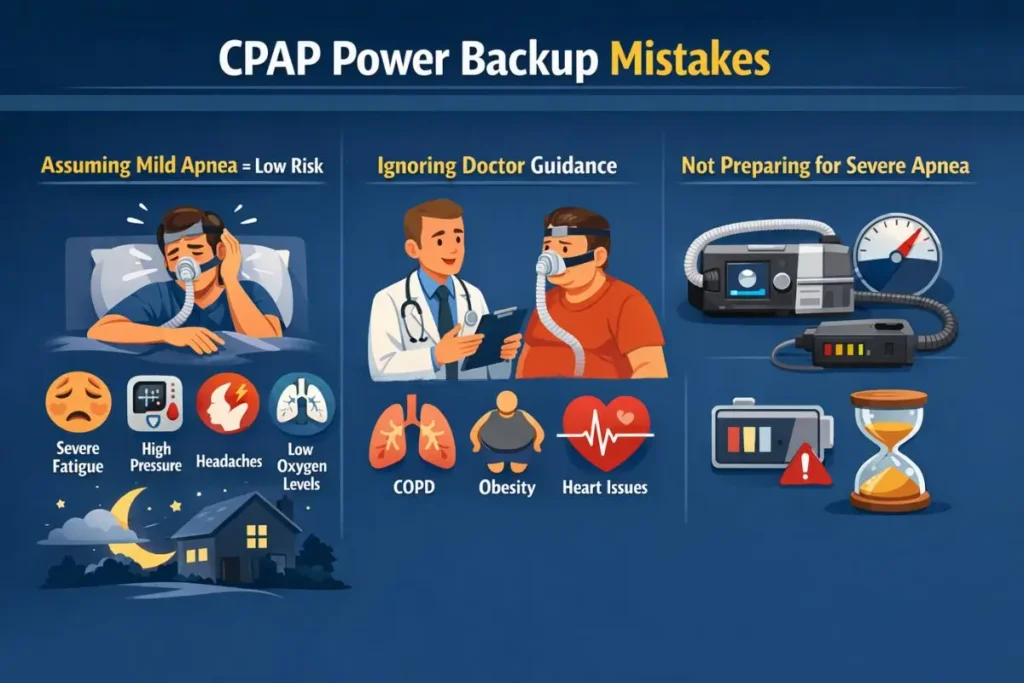
Medical Risk Mistakes Users Make

How to Build a Safe CPAP Backup Strategy

Avoiding It requires structure, repetition, and realism—not guesswork.

Testing Schedule

Commit to testing your full system every three months. Simulate a real outage by unplugging main power completely and running your CPAP under typical night settings.

Track:

  • Starting battery percentage
  • End-of-test battery percentage
  • Estimated full-night capacity

Documenting results eliminates uncertainty and reduces CPAP power backup mistakes.

Charging Routine

Create a predictable routine:

  • Recharge after each use
  • Monthly maintenance charging
  • Avoid long-term full depletion
  • Store in moderate temperatures

Consistency prevents the “dead battery surprise”—one of the most frustrating CPAP power backup mistakes.

Runtime Buffer

Never plan for exact usage. Add a 20–30% safety buffer. If you sleep 8 hours, prepare for 10 hours of runtime. Weather events are unpredictable, and stress may extend sleep disruptions.

A buffer protects against miscalculation-based It.

Equipment Placement

Keep your battery:

  • Elevated
  • Ventilated
  • Within arm’s reach
  • Away from moisture

Organization improves reaction speed during outages and minimizes emergency CPAP power backup mistakes.

Realistic Overnight Backup Planning

Preparation must reflect real-world conditions—not ideal ones.

Single-Night vs Multi-Night

If you live in an area with frequent short outages, one full-night battery may be sufficient. But in storm-prone or rural regions, outages can last several days. Planning only for a single night is one of the common CPAP power backup mistakes.

Travel vs Home Outages

Travel introduces new variables: unfamiliar power outlets, hotel grid failures, flight delays. Portable planning matters. Always carry tested backup options when traveling with CPAP equipment.

Many CPAP power backup mistakes happen away from home, where backup options are limited.

Seasonal Outages

Winter storms can freeze power lines. Summer heat waves strain grids. Hurricane seasons create multi-day outages. Your cpap emergency power planning should adjust seasonally.

Reassess before storm season begins. Seasonal neglect leads to repeated CPAP power backup mistakes year after year.
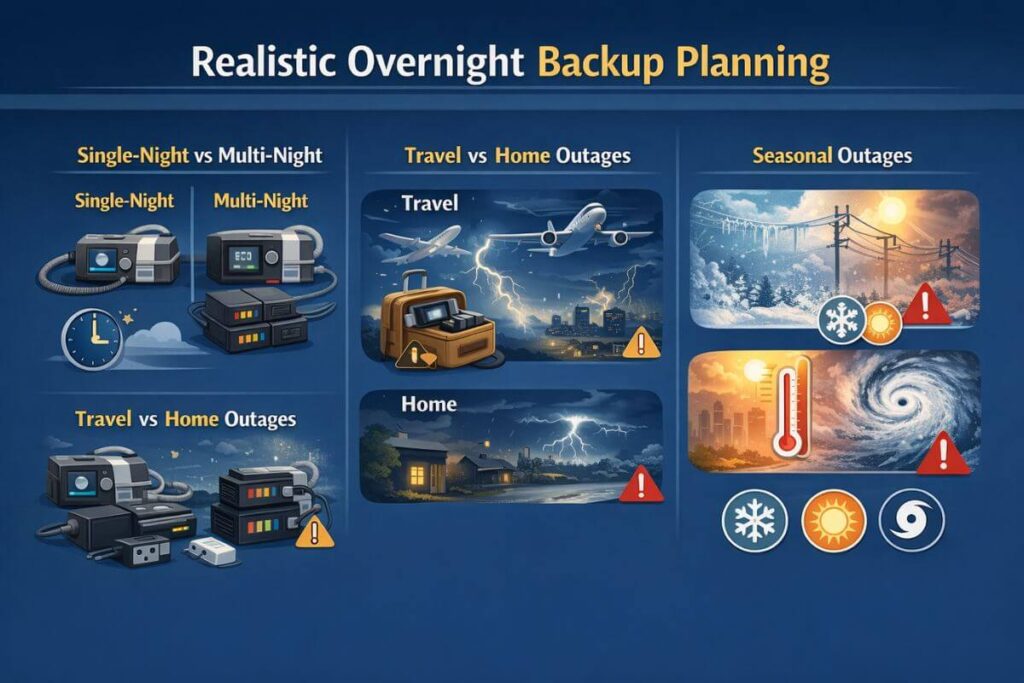
Realistic Overnight Backup Planning

FAQs

What is the biggest mistake CPAP users make during power outages?

The biggest CPAP power backup mistakes involve assuming a battery will last the entire night without testing it under real conditions. Lack of testing leads to overconfidence and mid-night failure.

Is a small battery enough for one night?

It depends on your pressure settings and humidifier usage. Many CPAP power backup mistakes occur when users underestimate actual consumption and forget runtime buffers.

What happens if backup power fails?

If both main power and backup fail, therapy stops. Severe apnea patients may experience fragmented sleep and oxygen drops. Having contingency plans reduces the risk of compounded CPAP power backup mistakes.

How should I prepare before a power outage?

Preparation includes testing equipment, charging batteries regularly, disabling humidifiers during battery use, and keeping cables organized. Avoiding CPAP power backup mistakes starts long before storm season.

Final Thoughts: Preparation Prevents Risk

CPAP power backup mistakes rarely happen because people don’t care. They happen because users assume “it won’t happen to me.” But power outages are unpredictable. Safety comes from planning, testing, and understanding your real energy needs. By eliminating common CPAP power backup mistakes, you protect your therapy, your sleep quality, and your overall health. Take action now—review your setup, test your system, and build a reliable backup plan before the next outage catches you off guard.

Related tags:

#cpapbackuppower #cpapbatterybackup #cpappoweroutage #cpappowersafety #portablepowerstationcpap
How Big a Battery Do You Need to Run a CPAP All Night Safely?

Battery Size for CPAP All Night

If you’re wondering about the battery size for CPAP all night, you’re not alone. A sudden power outage can interrupt therapy, compromise sleep quality, and even trigger serious health risks. Guessing your backup power needs is dangerous. The solution? Accurate calculations, realistic safety buffers, and informed planning. This guide walks you through everything — from CPAP power consumption per night to real-world battery math — so you can protect your therapy with confidence.

How Big a Battery Do You Need to Run a CPAP All Night Safely?

Why Battery Size Matters for Overnight CPAP Safety

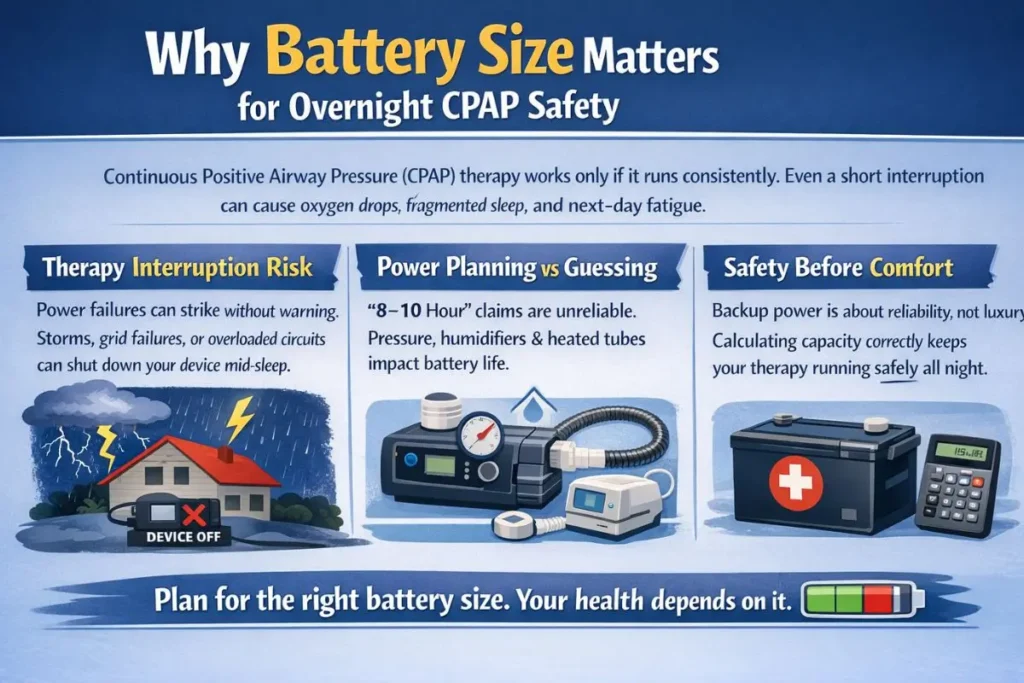
Continuous Positive Airway Pressure (CPAP) therapy works only if it runs consistently. Even a short interruption can cause oxygen drops, fragmented sleep, and next-day fatigue. For people with moderate to severe sleep apnea, therapy interruption risk is more than discomfort — it can increase cardiovascular strain.

Therapy Interruption Risk

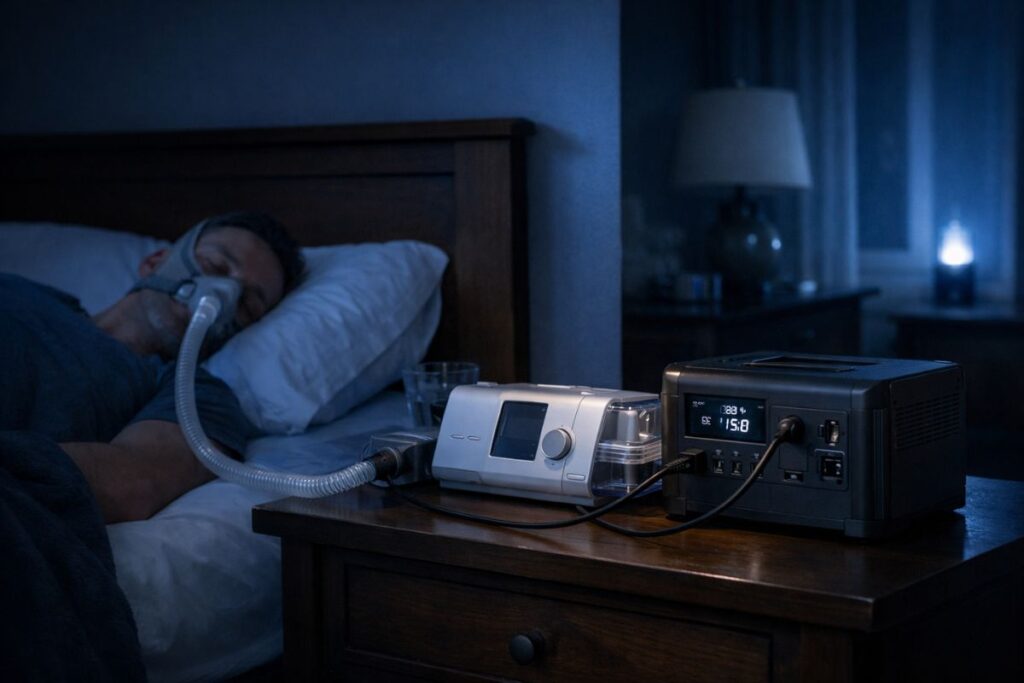
Power failures rarely come with warnings. Storms, grid failures, or overloaded circuits can shut down your device mid-sleep. Without the correct battery size for CPAP all night, your therapy may stop unexpectedly.

Power Planning vs Guessing

Many users rely on vague “8–10 hour runtime” claims. But every setup is different. Pressure levels, humidifiers, tubing heat, and inverter efficiency all impact how long CPAP runs on battery.

Safety Before Comfort

Backup power isn’t about luxury — it’s about medical reliability. Planning your CPAP battery capacity calculation properly ensures your therapy continues safely through the night.

Why Battery Size Matters for Overnight CPAP Safety

CPAP Power Consumption Per Night

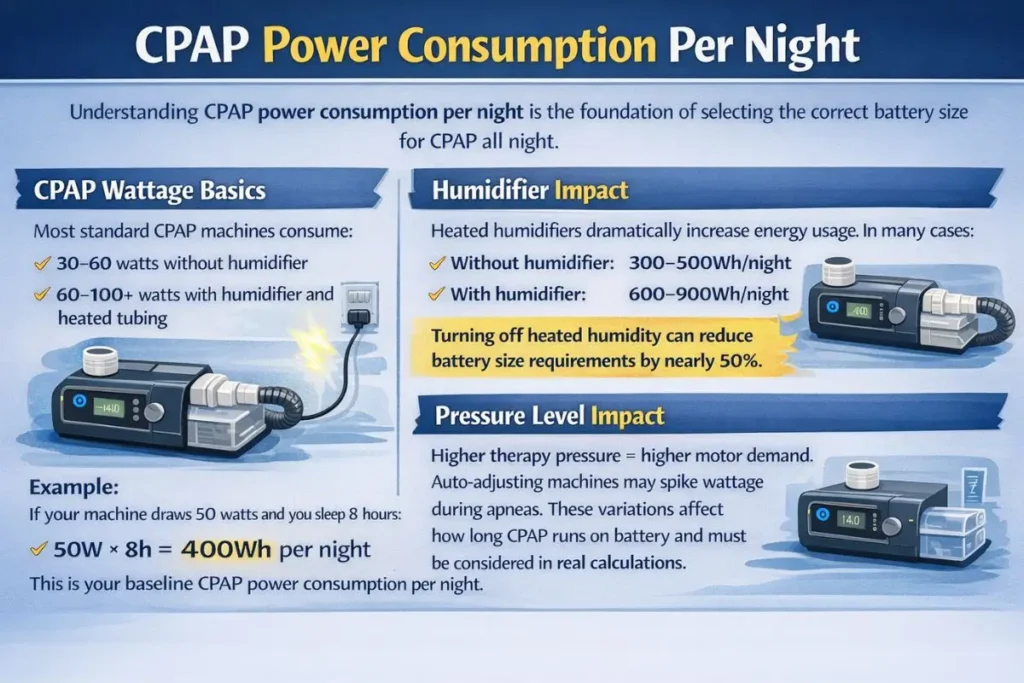
Understanding CPAP power consumption per night is the foundation of selecting the correct battery size for CPAP all night.

CPAP Wattage Basics

Most standard CPAP machines consume:

  • 30–60 watts without humidifier
  • 60–100+ watts with humidifier and heated tubing

To estimate nightly usage:

Watts × Hours = Watt-Hours (Wh)

Example:
If your machine draws 50 watts and you sleep 8 hours:

50W × 8h = 400Wh per night

This is your baseline CPAP power consumption per night.

Humidifier Impact

Heated humidifiers dramatically increase energy usage. In many cases:

  • Without humidifier: 300–500Wh/night
  • With humidifier: 600–900Wh/night

Turning off heated humidity can reduce battery size requirements by nearly 50%.

Pressure Level Impact

Higher therapy pressure = higher motor demand. Auto-adjusting machines may spike wattage during apneas. These variations affect how long CPAP runs on battery and must be considered in real calculations.

CPAP Power Consumption Per Night

CPAP Battery Capacity Calculation

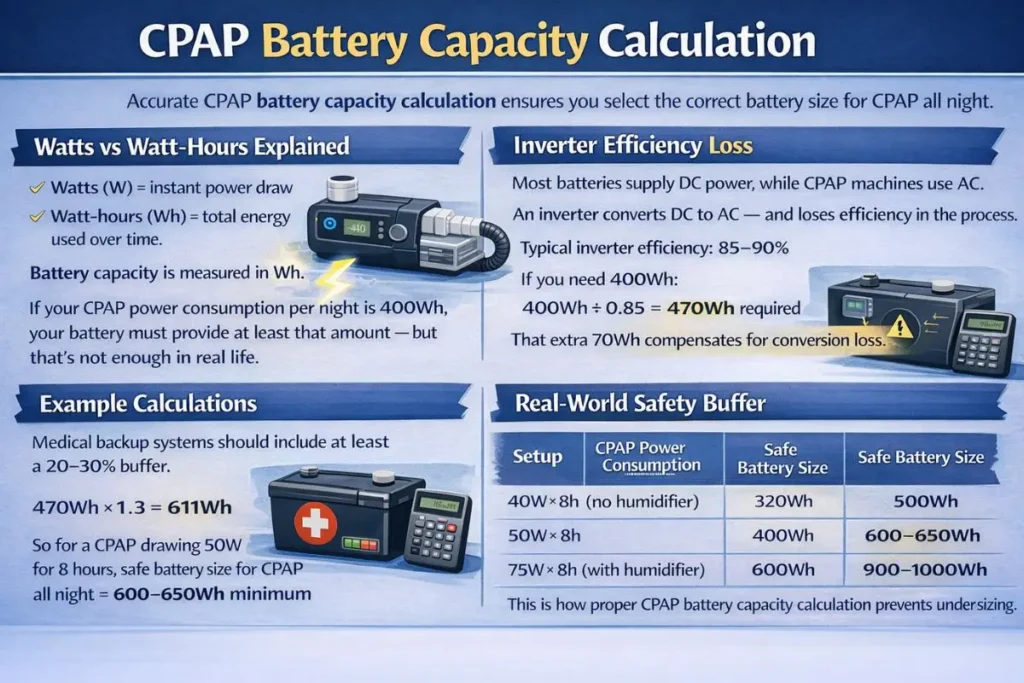
Accurate CPAP battery capacity calculation ensures you select the correct battery size for CPAP all night.

Watts vs Watt-Hours Explained

  • Watts (W) = instant power draw
  • Watt-hours (Wh) = total energy used over time

Battery capacity is measured in Wh.

If your CPAP power consumption per night is 400Wh, your battery must provide at least that amount — but that’s not enough in real life.

Inverter Efficiency Loss

Most batteries supply DC power, while CPAP machines use AC. An inverter converts DC to AC — and loses efficiency in the process.

Typical inverter efficiency: 85–90%

If you need 400Wh:

400Wh ÷ 0.85 = 470Wh required

That extra 70Wh compensates for conversion loss.

Real-World Safety Buffer

Medical backup systems should include at least a 20–30% buffer.

470Wh × 1.3 = 611Wh

So for a CPAP drawing 50W for 8 hours, safe battery size for CPAP all night = 600–650Wh minimum

Example Calculations

SetupCPAP Power Consumption Per NightSafe Battery Size
40W × 8h (no humidifier)320Wh500Wh
50W × 8h400Wh600–650Wh
75W × 8h (with humidifier)600Wh900–1000Wh

This is how proper CPAP battery capacity calculation prevents under-sizing.

CPAP Battery Capacity Calculation

How Long CPAP Runs on Battery

Understanding how long CPAP runs on battery depends on battery capacity and device load.

Single Night Backup

If you own a 500Wh battery:

500Wh × 0.85 inverter efficiency = 425Wh usable

If CPAP consumes 400Wh:

You get approximately 1 full night (with minimal buffer).

Multi-Night Planning

For 2 nights without recharging:

400Wh × 2 = 800Wh
800Wh ÷ 0.85 = 941Wh
Add 30% buffer → 1223Wh

You’d need roughly 1200Wh battery capacity for two safe nights.

Emergency Scenarios

During disasters, recharge options may be limited. Planning for extended outages means increasing battery size for CPAP all night across multiple nights, not just one.

What Affects CPAP Battery Runtime

Several environmental and equipment factors influence how long CPAP runs on battery.

Temperature

Cold weather reduces lithium battery efficiency by up to 20%. Outdoor camping scenarios require larger capacity planning.

Humidifier

Heated humidification is the largest energy drain. Disabling it can double runtime.

Tubing Heat

Heated tubing adds additional wattage demand — especially in cold rooms.

Device Age

Older CPAP machines may draw more power due to motor wear. Always verify your actual CPAP power consumption per night using a watt meter.

Best Battery Backup for CPAP Safety

Choosing the best battery backup for CPAP safety is about electrical compatibility and capacity — not branding.

Portable Power Stations

Large lithium power stations provide high Wh capacity and built-in inverters. When selecting battery size for CPAP all night, confirm:

  • Sufficient Wh rating
  • Continuous output wattage rating above CPAP peak draw

CPAP-Specific Batteries

Some batteries connect directly via DC output, avoiding inverter loss. This improves how long CPAP runs on battery and reduces required capacity.

Pure Sine Wave Requirement

CPAP motors require pure sine wave AC output. Modified sine wave inverters may cause malfunction or long-term damage.

Safety rule: Always verify waveform compatibility before purchasing backup power.

Best Battery Backup for CPAP Safety

Common Mistakes When Choosing CPAP Battery

Selecting incorrect battery size for CPAP all night can result in therapy failure.

Buying Too Small

Many users calculate only watts × hours and ignore inverter loss and buffer. This leads to shutdown before morning.

Ignoring Inverter Loss

Forgetting 10–15% efficiency loss results in inaccurate CPAP battery capacity calculation.

Trusting Manufacturer Runtime Claims

Generic “10-hour runtime” labels assume ideal lab conditions. Real-world CPAP power consumption per night varies widely.

Safety Planning Before a Power Outage

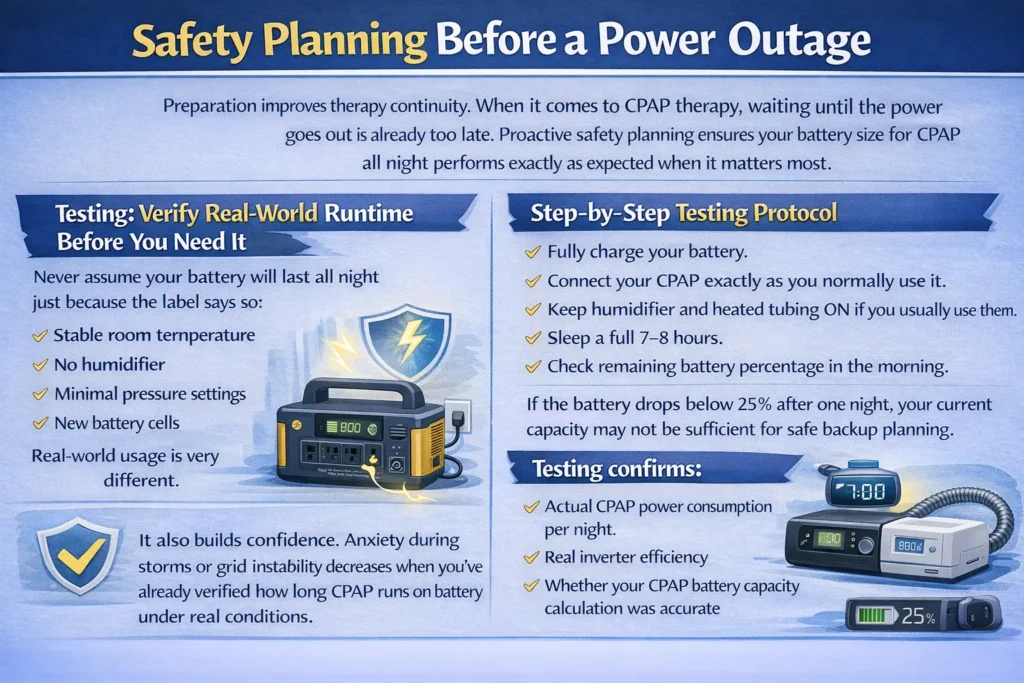
Preparation improves therapy continuity. When it comes to CPAP therapy, waiting until the power goes out is already too late. Proactive safety planning ensures your battery size for CPAP all night performs exactly as expected when it matters most.

Backup power is not something you “hope” works — it’s something you verify, test, and maintain like essential medical equipment.

Testing: Verify Real-World

Runtime Before You Need It

Never assume your battery will last all night just because the label says so.

Manufacturer runtime claims are typically calculated under ideal lab conditions:

  • Stable room temperature
  • No humidifier
  • Minimal pressure settings
  • New battery cells

Real-world usage is very different.

Step-by-Step Testing Protocol

  1. Fully charge your battery.
  2. Connect your CPAP exactly as you normally use it.
  3. Keep humidifier and heated tubing ON if you usually use them.
  4. Sleep a full 7–8 hours.
  5. Check remaining battery percentage in the morning.

If the battery drops below 25% after one night, your current capacity may not be sufficient for safe backup planning.

Testing confirms:

  • Actual CPAP power consumption per night
  • Real inverter efficiency
  • Whether your CPAP battery capacity calculation was accurate

It also builds confidence. Anxiety during storms or grid instability decreases when you’ve already verified how long CPAP runs on battery under real conditions.

Safety Planning Before a Power Outage

Placement: Protect Both the Battery and Your Safety

Where you place your battery directly impacts performance, lifespan, and safety.

Ventilation Matters

Lithium batteries generate mild heat during discharge and charging. Always:

  • Keep the battery on a hard, flat surface
  • Avoid covering it with fabric
  • Leave airflow space around vents

Never place battery units:

  • Under blankets
  • Inside closed drawers
  • Against heating vents

Proper ventilation prevents overheating and extends battery health.

Avoid Temperature Extremes

Battery chemistry is highly sensitive to temperature.

  • Below 32°F (0°C): Capacity can drop 15–25%
  • Above 95°F (35°C): Long-term cell degradation increases

If you rely on your battery size for CPAP all night during winter storms or summer heat waves, indoor climate control becomes part of safety planning.

Cold batteries discharge faster.
Hot batteries age faster.

Neither scenario is ideal during a medical event.

Charging Habits: Extend Battery Lifespan Safely

Lithium batteries degrade based on charge cycles and storage behavior. Poor charging habits can reduce effective capacity over time — which changes how long CPAP runs on battery.

Optimal Storage Range

For long-term storage:

  • Keep battery between 20% and 80% charge
  • Avoid leaving at 100% for months
  • Avoid storing completely drained

Fully charge only:

  • The day before expected storms
  • During high-risk seasons (hurricane, snowstorm periods)
  • Before travel or camping trips

Monthly Maintenance Routine

To maintain reliable best battery backup for CPAP safety, follow this simple schedule:

  • Once per month: power on battery and check health indicators
  • Every 3–4 months: perform a short runtime test
  • Every 6 months: do a full overnight simulation

This ensures your backup plan remains accurate as battery cells naturally age.

Seasonal Risk Planning

Power outage probability changes based on location and season.

If you live in:

  • Storm-prone coastal areas
  • Snow-heavy northern climates
  • Rural regions with unstable grid access

You should reassess your CPAP battery capacity calculation annually.

Battery capacity slowly decreases over years. A system that once provided 8 hours may later provide 6–7 hours.

That difference matters at 3 AM.

Emergency Preparedness Checklist

Before storm season, confirm:

✔ Battery fully charged
CPAP tested overnight
✔ Extension cords inspected
✔ Inverter functioning properly
✔ Backup location accessible in the dark
✔ Flashlight nearby
✔ Replacement filters stocked

Emergency readiness is about eliminating variables.

Know Your Limits

Even with correct battery size for CPAP all night, understand limitations:

  • Multi-night outages require recharge planning
  • Solar charging requires sunlight consistency
  • Car charging requires fuel availability
  • Public charging stations may be unavailable during disasters

Always calculate realistic expectations — not optimistic ones.

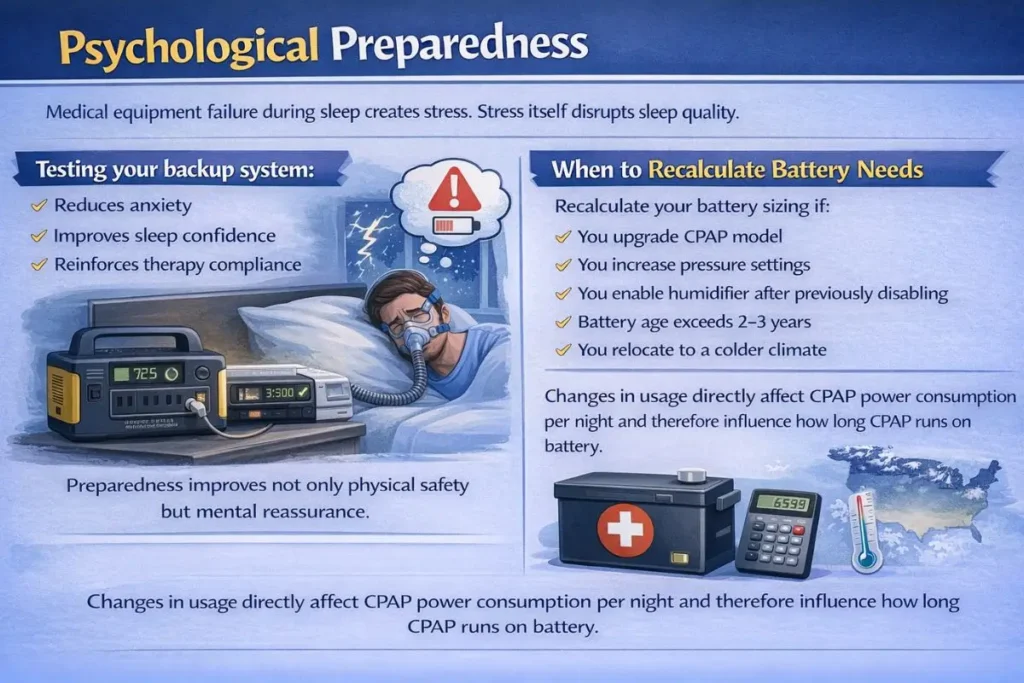
Psychological Preparedness

Medical equipment failure during sleep creates stress. Stress itself disrupts sleep quality.

Testing your backup system:

  • Reduces anxiety
  • Improves sleep confidence
  • Reinforces therapy compliance

Preparedness improves not only physical safety but mental reassurance.

When to Recalculate Battery Needs

Recalculate your battery sizing if:

  • You upgrade CPAP model
  • You increase pressure settings
  • You enable humidifier after previously disabling
  • Battery age exceeds 2–3 years
  • You relocate to a colder climate

Changes in usage directly affect CPAP power consumption per night and therefore influence how long CPAP runs on battery.

Emergency Preparedness Checklist

Final Safety Reminder

Your CPAP machine is medical equipment — and your backup power system should be treated the same way.

Planning ahead ensures:

  • Continuous therapy
  • Cardiovascular protection
  • Sleep stability
  • Peace of mind

Proactive preparation ensures the correct battery size for CPAP all night functions reliably when needed most — not just theoretically, but in real-world conditions.

FAQs

How many Wh are needed for CPAP?

Most users need 500–700Wh for one safe night without humidifier. With heated humidifier, 800–1000Wh may be required. Accurate CPAP battery capacity calculation depends on actual watt draw, inverter efficiency, and safety buffer. Always measure CPAP power consumption per night before selecting battery size for CPAP all night.

Can a small battery run a CPAP overnight?

Small batteries under 300Wh usually cannot run standard CPAP machines for 8 hours unless humidifier is off and wattage is very low. After accounting for inverter loss, usable capacity drops further. This often leads to therapy interruption before morning.

How does humidifier affect battery life?

Heated humidifiers can double CPAP power consumption per night. A machine drawing 40W without humidity may draw 75–90W with heat enabled. That dramatically reduces how long CPAP runs on battery and increases required battery size for CPAP all night.

How often should I replace my CPAP backup battery?

Most lithium battery systems last:

  • 500–2000 charge cycles
  • 3–7 years depending on usage

However, effective capacity decreases gradually.

Recalculate your CPAP battery capacity calculation every 12–24 months to confirm your battery still meets the required battery size for CPAP all night.

Should I plan for more than one night?

If you live in areas prone to storms or grid instability, multi-night capacity planning is safer. Extend CPAP battery capacity calculation accordingly.

Does turning off the humidifier increase battery runtime significantly?

Yes — dramatically.

Heated humidifiers can double CPAP power consumption per night. Turning off humidity may reduce draw from 70–90W down to 30–50W.

In real terms, this can:

  • Reduce required battery size by 30–50%
  • Extend how long CPAP runs on battery by several hours

If emergency power is limited, disabling humidifier is often the fastest way to preser

Medical Reliability Requires Electrical Planning

CPAP therapy is a prescribed medical treatment, not a comfort device. Interruptions in therapy can lead to:

  • Oxygen desaturation
  • Sleep fragmentation
  • Increased cardiovascular stress
  • Morning headaches and fatigue

Proper planning for the correct battery size for CPAP all night protects more than convenience — it protects physiological stability during sleep.

From a safety standpoint, your backup system should be treated as:

  • A medical contingency plan
  • A verified electrical solution
  • A maintained emergency resource

Accurate CPAP battery capacity calculation, real-world runtime testing, and understanding how long CPAP runs on battery are not optional steps — they are responsible therapy management practices.

Prepared users sleep confidently. Unprepared users gamble on assumptions.

Electrical reliability is part of therapy compliance.

related tags:

#cpapbackuppower #cpapbatterybackup #cpappoweroutage #cpappowersafety #portablepowerstationcpap
Categories Uncategorized

Pure Sine Wave vs Modified Sine Wave: Why It Matters for CPAP Machines

Pure Sine Wave vs Modified Sine Wave

When planning backup power for sleep therapy, one question comes up repeatedly: pure sine wave vs modified sine wave cpap — does it actually matter, or is it just technical marketing language?

For a CPAP user, the answer is not theoretical. The type of electrical waveform powering the machine directly affects motor stability, humidifier behavior, and long-term device safety. Understanding pure sine wave vs modified sine wave cpap setups helps prevent therapy interruptions, equipment stress, and unsafe power choices.

This guide explains the difference in simple terms, includes real calculations, and shows why waveform quality matters when running a CPAP machine.

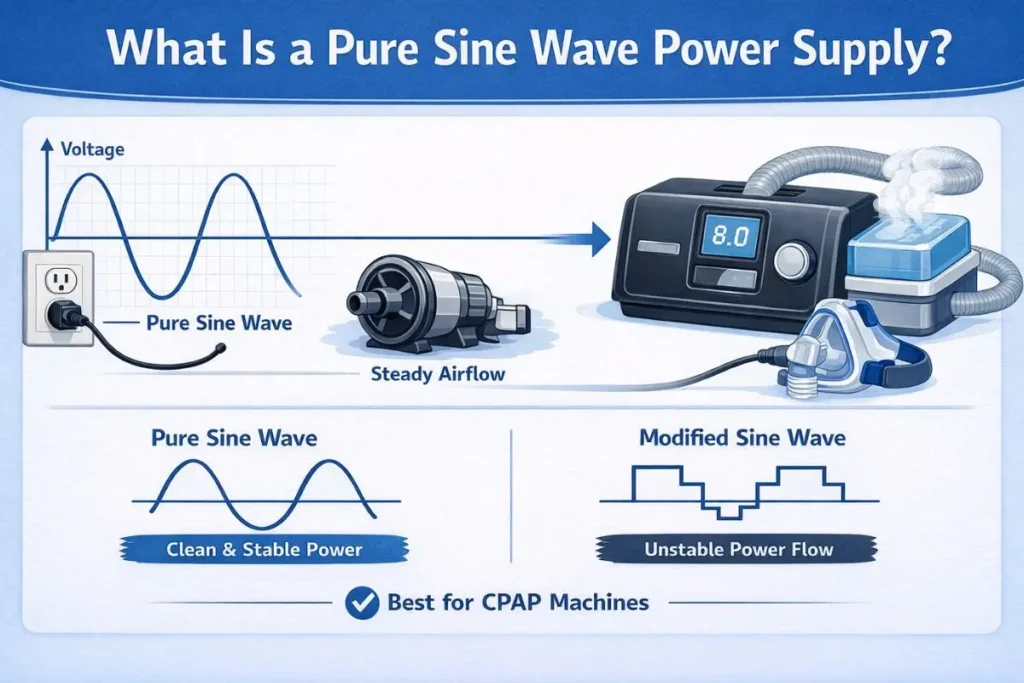
What Is a Pure Sine Wave Power Supply?

Utility electricity from your wall outlet follows a smooth, continuous waveform. This clean pattern is called a pure sine wave. Medical devices, including CPAP machines, are designed to operate using this stable electrical flow.

The airflow motor inside a CPAP machine relies on consistent voltage delivery. When power flows smoothly, the motor maintains steady pressure, and the humidifier heating element behaves predictably. This is why pure sine wave power is considered the safest match for CPAP electronics.

Understanding pure sine wave vs modified sine wave cpap decisions starts here — CPAP machines are engineered around clean AC power.

What Is a Pure Sine Wave Power Supply?

What Is Modified Sine Wave Power?

Modified sine wave power comes from budget inverters and some lower-cost battery systems. Instead of smooth electricity, it delivers a stepped waveform that approximates AC power.

It can run simple devices like lights, fans, or phone chargers. But devices with motors, heating components, and control electronics respond differently.

When comparing pure sine wave vs modified sine wave cpap setups, the biggest difference is how the machine behaves under load — not just whether it turns on.

Pure vs Modified Sine Wave: The Core Electrical Difference

The waveform determines how electricity flows through a CPAP’s internal components.

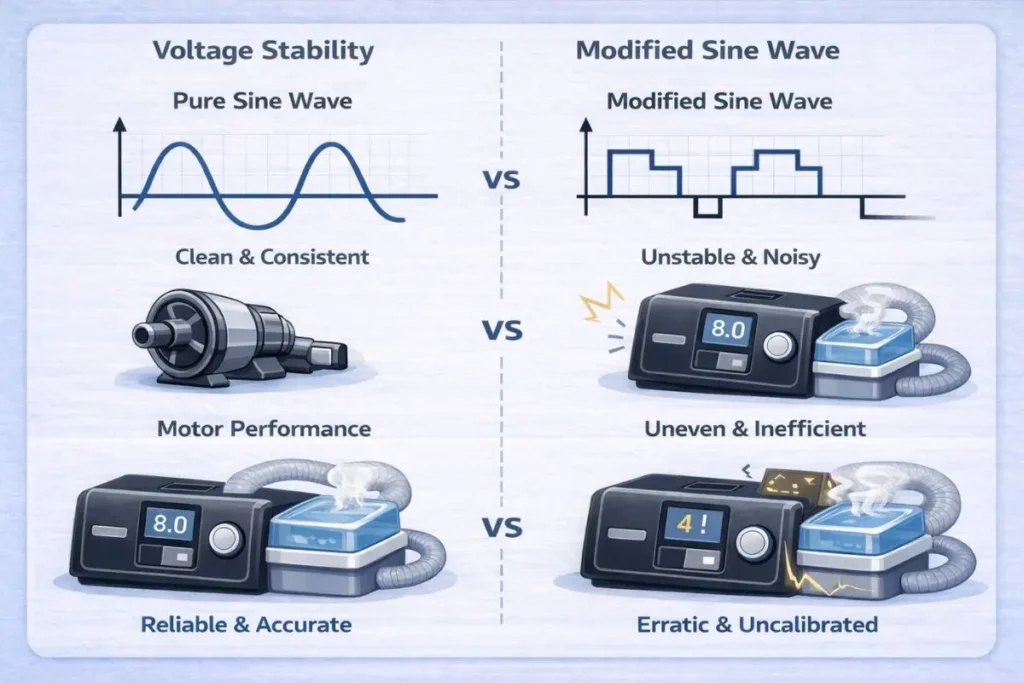
Voltage Stability

Pure sine wave delivers consistent voltage with minimal fluctuation. Modified sine wave introduces sharp transitions that create electrical noise and instability.

Motor Performance

CPAP airflow motors depend on stable current. With pure sine wave, the motor operates smoothly. With modified sine wave, the motor may draw uneven power, leading to vibration or inefficiency.

Electronic Control Systems

Modern CPAP machines include sensors and microprocessors. These rely on clean power. Irregular waveform input can affect calibration and pressure adjustments.

This is why pure sine wave vs modified sine wave cpap discussions are not just technical debates — they impact real therapy performance.

Pure vs Modified Sine Wave

Why CPAP Machines Need Pure Sine Wave Power

Sensitive Electronics

CPAP machines regulate airflow using internal circuitry. Clean power prevents electrical stress and reduces long-term component wear.

Pressure Consistency

Sleep therapy depends on steady pressure. Waveform instability can lead to small fluctuations that affect therapy effectiveness.

Humidifier Heating Stability

Heated humidifiers require stable energy flow. Modified waveforms can create uneven heating, increased current draw, or inefficient operation.

Pure sine wave vs modified sine wave cpap planning is therefore part of safety preparation, not just convenience.

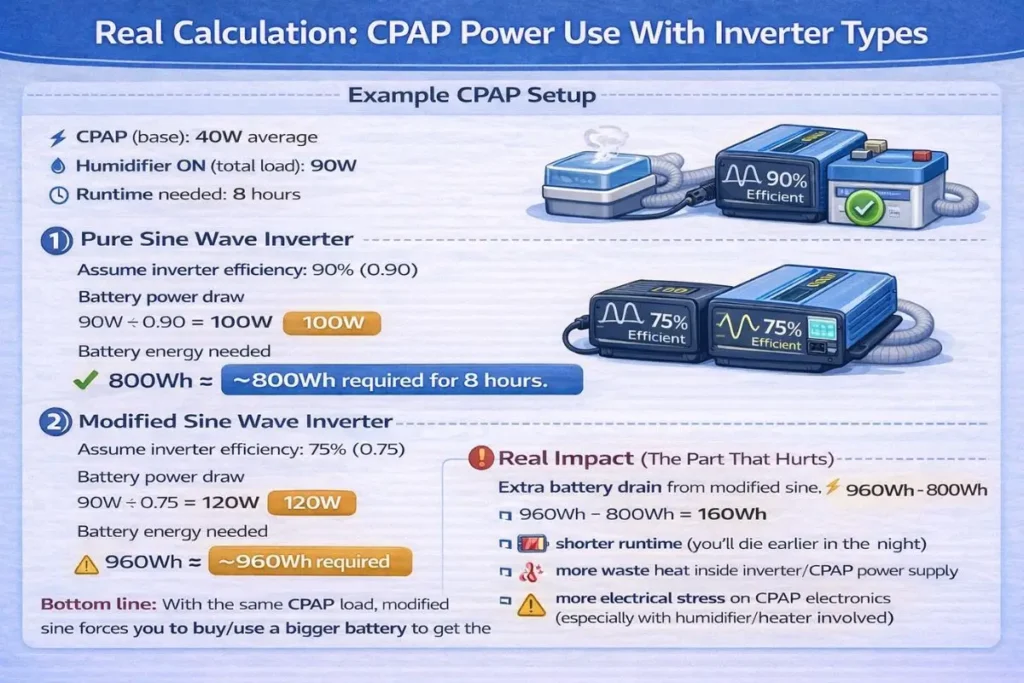
Real Calculation: CPAP Power Use With Inverter Types

Let’s break this down using real numbers.

Example CPAP Setup

  • CPAP machine: 40W average
  • Humidifier active: 90W total load
  • Runtime needed: 8 hours

Using Pure Sine Wave Inverter

Assume inverter efficiency: 90%

Power drawn from battery:

90W ÷ 0.90 = 100W actual consumption

Battery energy required:

100W × 8 hours = 800Wh

Using Modified Sine Wave Inverter

Efficiency drops due to waveform loss.

Assume efficiency: 75%

90W ÷ 0.75 = 120W actual consumption

Battery energy required:

120W × 8 hours = 960Wh

Real Impact

Modified wave increases battery drain by:

960Wh − 800Wh = 160Wh loss

That equals:

  • reduced runtime
  • increased heat
  • higher stress on electronics

This is the practical side of pure sine wave vs modified sine wave cpap decisions.

CPAP Power Use With Inverter Types

Risks of Using Modified Sine Wave With CPAP

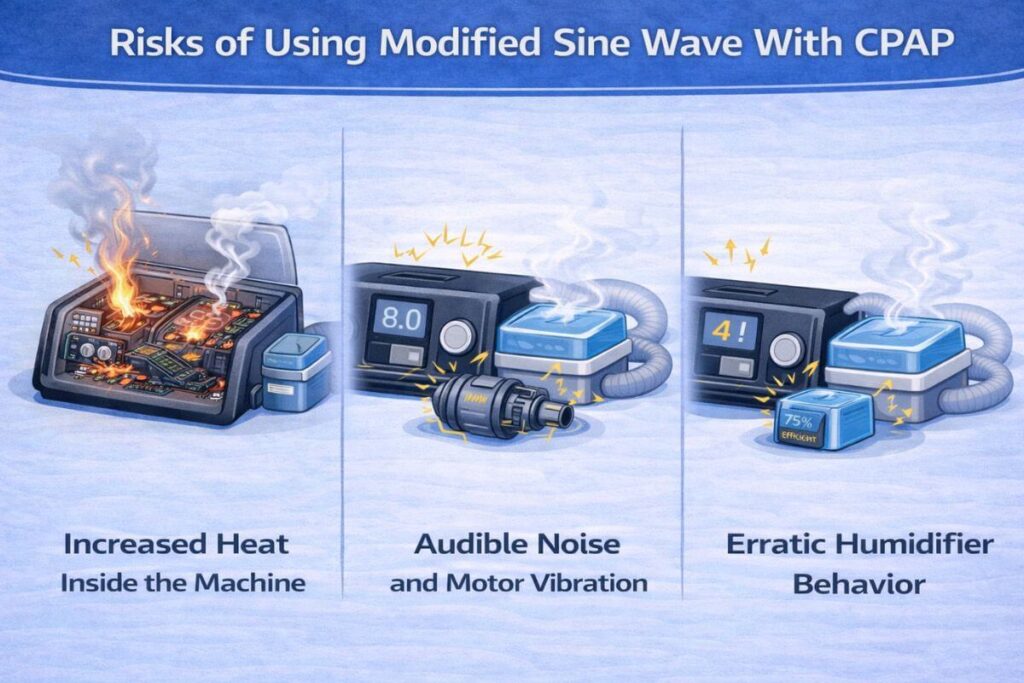
Increased Heat Inside the Machine

Modified sine wave electricity is not smooth. It delivers power in abrupt steps rather than a continuous flow. Inside a CPAP machine, this creates extra electrical resistance within the power supply and motor circuitry.

Over time, this resistance generates heat. The device may still function, but internal components are working harder than intended. Consistent heat exposure can shorten the lifespan of electronic parts and affect reliability during long-term use.

Audible Noise and Motor Vibration

Some users notice a faint buzzing or vibration when a CPAP runs on modified sine wave power. This happens because the airflow motor is not receiving a stable electrical signal.

Instead of rotating smoothly, the motor compensates for uneven power input. The result is subtle mechanical stress that may not seem serious at first, but it reflects inefficiency in operation.

Erratic Humidifier Behavior

Humidifiers rely on stable current to maintain consistent heating. When powered by modified sine wave electricity, the heating element may draw power unevenly.

This can lead to:

  • inconsistent warmth
  • increased power consumption
  • reduced runtime from batteries

While the humidifier may still function, efficiency drops and overall system stability decreases.

Long-Term Component Stress

Repeated exposure to irregular electrical flow can gradually affect internal circuitry. Motor drivers, voltage regulators, and control boards experience additional stress.

Damage rarely happens immediately. Instead, it appears over months of use — reduced reliability, unexpected shutdowns, or inconsistent performance.

The machine may run — but running is not the same as operating safely or efficiently.

Modified Sine Wave With CPAP

How to Check If Your Power Source Is Pure Sine Wave

Read the Specifications Carefully

Reliable power sources clearly mention “pure sine wave output” in their technical specifications. This is the first thing to verify before using any inverter or portable power system for CPAP therapy.

Be Cautious With Generic Inverter Labels

Lower-cost inverters often avoid clearly stating waveform type. If the documentation does not explicitly confirm pure sine wave output, it is usually modified.

Assuming compatibility without checking can lead to unstable operation later.

Check CPAP Manufacturer Guidance

Many CPAP manuals include recommended power requirements. Some explicitly state the need for pure sine wave electricity, especially when humidifiers are involved.

Following manufacturer guidance ensures both safety and long-term device reliability.

Understanding pure sine wave vs modified sine wave cpap compatibility prevents mistakes before purchasing backup equipment.

Backup Planning for CPAP Power Safety

Home Power Outages

Unplannedoutages are when waveform quality matters most. A reliable pure sine wave power station allows the CPAP to continue operating without sudden interruptions or performance changes.

Travel and Portable Use

When traveling, users often rely on battery systems. Ensuring those systems provide clean power prevents unexpected behavior in unfamiliar environments.

Emergency Preparedness

Planning before emergencies reduces panic. Knowing that your backup system delivers stable electricity allows therapy to continue without confusion or guesswork.

Common Mistakes CPAP Users Make

Choosing the Cheapest Inverter

Budget equipment may seem sufficient, especially if the machine powers on. But waveform quality is rarely prioritized in low-cost systems, which affects performance over time.

Ignoring Efficiency Loss

Modified sine wave systems waste more energy. This leads to faster battery drain and shorter runtime — a critical issue during overnight use.

Assuming “If It Runs, It’s Safe”

Many users believe that if the CPAP turns on, the setup is acceptable. In reality, stability, efficiency, and long-term reliability matter more than initial operation.

The difference between pure sine wave vs modified sine wave cpap setups becomes visible over time, not instantly.

Frequently Asked Questions About Pure Sine Wave vs Modified Sine Wave for CPAP

Does a CPAP machine require pure sine wave power?

Most modern CPAP devices operate best with pure sine wave electricity. It ensures stable airflow motor behavior, protects electronics, and prevents inefficient energy use.

Is modified sine wave dangerous for CPAP machines?

It isn’t immediately dangerous in every case, but it increases electrical stress, heat, and inefficiency. Over time, it may affect device performance and reliability.

Will using modified sine wave reduce battery runtime?

Yes. Efficiency loss means the battery drains faster, reducing overnight operating time.

Why does waveform matter if the CPAP turns on?

Because turning on is not the goal — stable therapy is. Waveform quality affects motor smoothness, humidifier heating, and internal circuitry.

What type of inverter is safest for CPAP backup power?

Pure sine wave inverters provide the closest match to household electricity and are generally safest for medical devices.

Is pure sine wave necessary if my CPAP doesn’t use a humidifier?

Humidifiers increase power demand, but even without one, the airflow motor and internal electronics still benefit from stable power. Pure sine wave supports smoother operation and reduces electrical stress, regardless of added features.

Is investing in pure sine wave backup worth it for CPAP users?

For people who rely on CPAP therapy nightly, power reliability directly affects sleep quality and safety. A pure sine wave backup system supports stable operation, improves runtime efficiency, and reduces long-term equipment stress, making it a practical long-term choice.

Related tags:

#cpapbackuppower #cpapbatterybackup #cpappoweroutage #cpappowersafety #portablepowerstationcpap
Categories Uncategorized

CPAP Power Failure During Sleep: Health Effects, Risks & Safety Rules

CPAP Power Failure During Sleep

CPAP power failure during sleep is something many users don’t think about until it actually happens. The machine runs quietly every night, and it’s easy to assume therapy will continue without interruption. But when power suddenly stops, airflow stops with it — and that can be confusing, uncomfortable, and sometimes risky depending on the user’s condition.

Understanding how cpap power failure during sleep affects breathing, sleep quality, and safety helps users prepare instead of reacting in panic. This guide explains what happens physically, what health risks exist, and what safety steps matter most.

Why CPAP Power Failure During Sleep Is a Serious Issue

CPAP Therapy Depends on Continuous Airflow

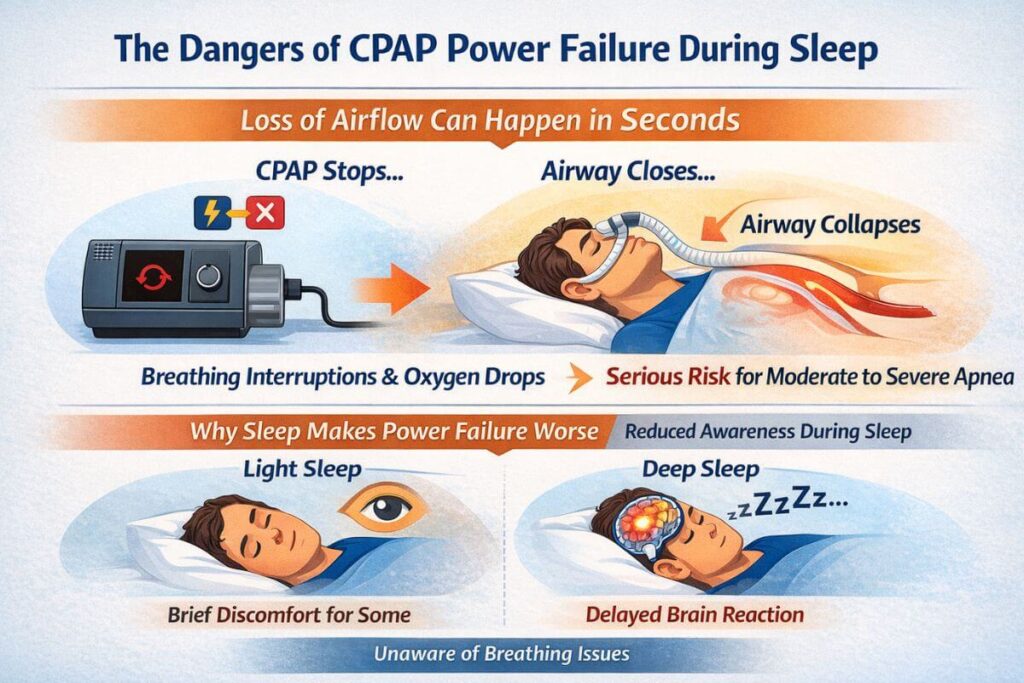
CPAP therapy works by maintaining consistent air pressure that keeps the airway open. The moment electricity stops, therapy stops. The airway can collapse again, and breathing patterns return to untreated sleep apnea conditions.

This change can happen within seconds. For some users it leads to brief discomfort. For others, especially those with moderate or severe apnea, it can lead to repeated breathing interruptions.

Why Sleep Makes Power Failure Riskier

When awake, a person notices airflow changes quickly. During sleep, awareness is reduced. The brain may take longer to respond, especially during deeper sleep stages. This delay is what makes cpap power failure during sleep more concerning than daytime interruption.

Why CPAP Power Failure During Sleep Is a Serious Issue

What Happens When a CPAP Stops Working at Night

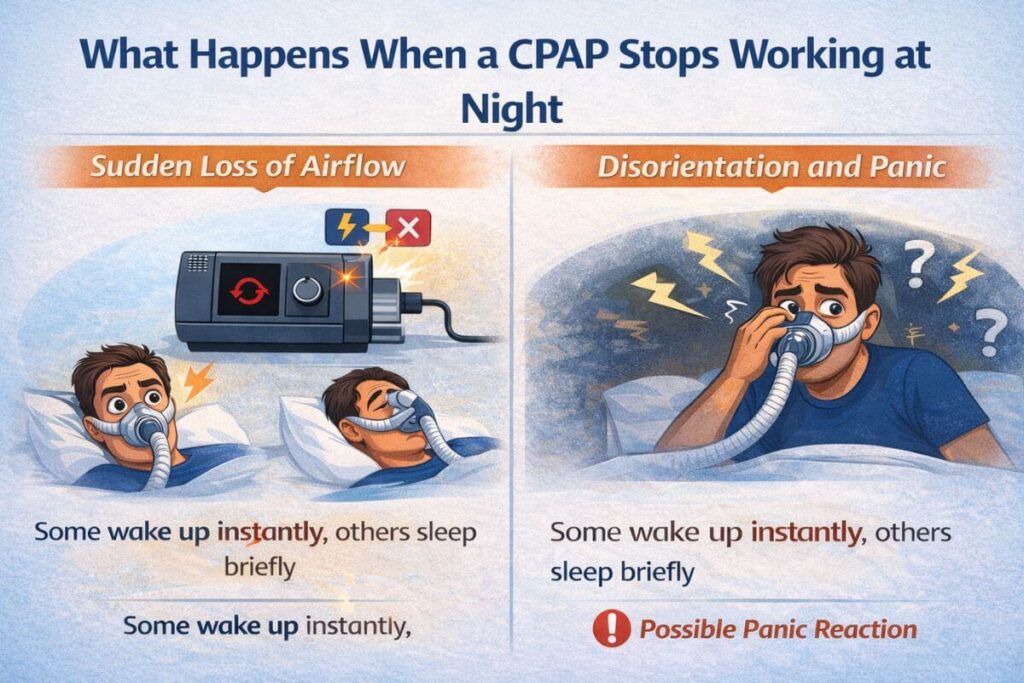
Sudden Loss of Airflow

The most immediate effect of cpap power failure during sleep is airflow stopping instantly. There is no gradual decrease. The mask pressure changes and breathing resistance may feel different.

Some users wake immediately. Others remain asleep briefly, depending on sleep depth.

Breathing Through the Mask Without Pressure

Most CPAP masks allow passive breathing if power stops. However, breathing can feel unfamiliar or uncomfortable. This sensation alone can trigger anxiety when waking.

Disorientation and Panic

Waking up suddenly without airflow can cause confusion, especially in darkness. Some users feel shortness of breath before fully waking, which may increase panic response.

What Happens When a CPAP Stops Working at Night

Health Effects of CPAP Power Failure During Sleep

Mild Sleep Apnea

Users with mild apnea may experience disturbed sleep and fatigue the next day. Health risk is usually lower, but repeated interruptions reduce therapy effectiveness.

Moderate Sleep Apnea

Apnea events return quickly. Oxygen levels may fluctuate, and the body enters stress response. Repeated occurrences affect sleep quality and cardiovascular health over time.

Severe Sleep Apnea

For severe apnea, cpap power failure during sleep may result in rapid oxygen drops and increased strain on the heart. People with existing heart or lung conditions are more vulnerable.

Why Some Users Don’t Wake Immediately

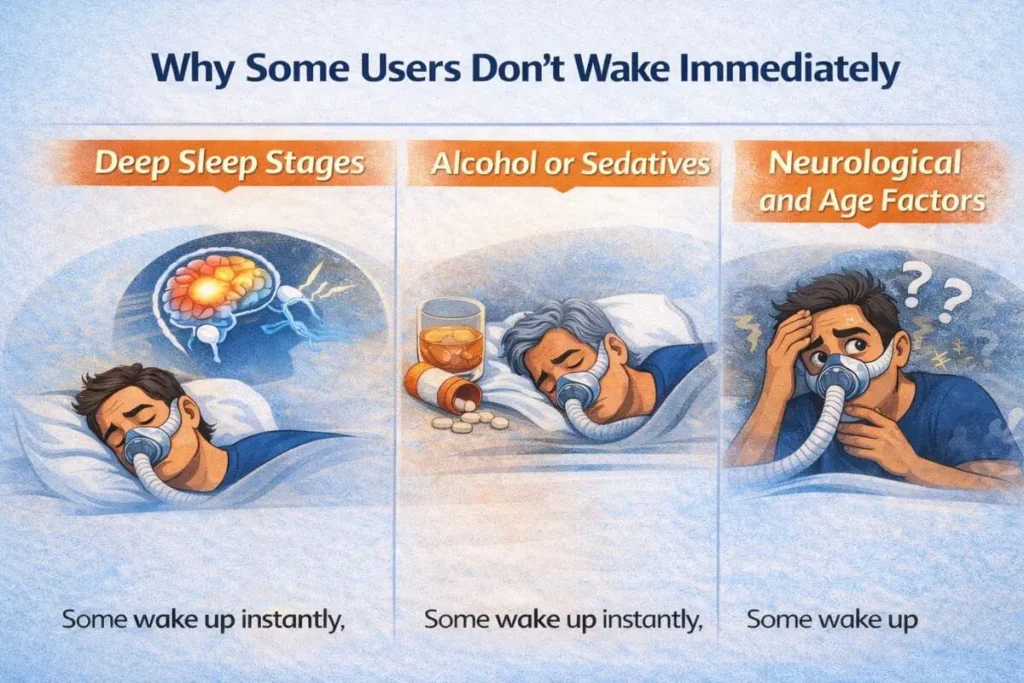
Deep Sleep Stages

During deeper stages of sleep, the brain reduces responsiveness to external and internal changes. Airflow interruptions may not trigger immediate awakening, especially during slow-wave sleep. In these stages, the body is focused on recovery and neurological rest, and breathing disruptions can take longer to register.

When cpap power failure during sleep occurs at this point, the user may continue sleeping for several seconds or even minutes before becoming aware that airflow has stopped. This delay is one of the reasons uninterrupted therapy is important, particularly for people with moderate to severe apnea.

Alcohol or Sedatives

Alcohol and sleep medications affect how the brain responds to breathing changes. These substances can suppress the body’s natural alert system, making it slower to detect airflow loss. As a result, cpap power failure during sleep may go unnoticed for longer than usual.

For users who rely on nightly medication or occasionally consume alcohol, this factor increases the importance of stable power and backup planning.

Neurological and Age Factors

Older adults and individuals with neurological conditions may experience slower awakening responses. Sensory processing, reaction time, and breathing awareness can be affected by age-related changes.

When airflow stops, their body may take longer to respond, which extends the period without therapy. This does not happen in every case, but it is a realistic factor to consider when preparing for power interruptions.

Why Some Users Don’t Wake Immediately

Safety Risks During Nighttime CPAP Power Failure

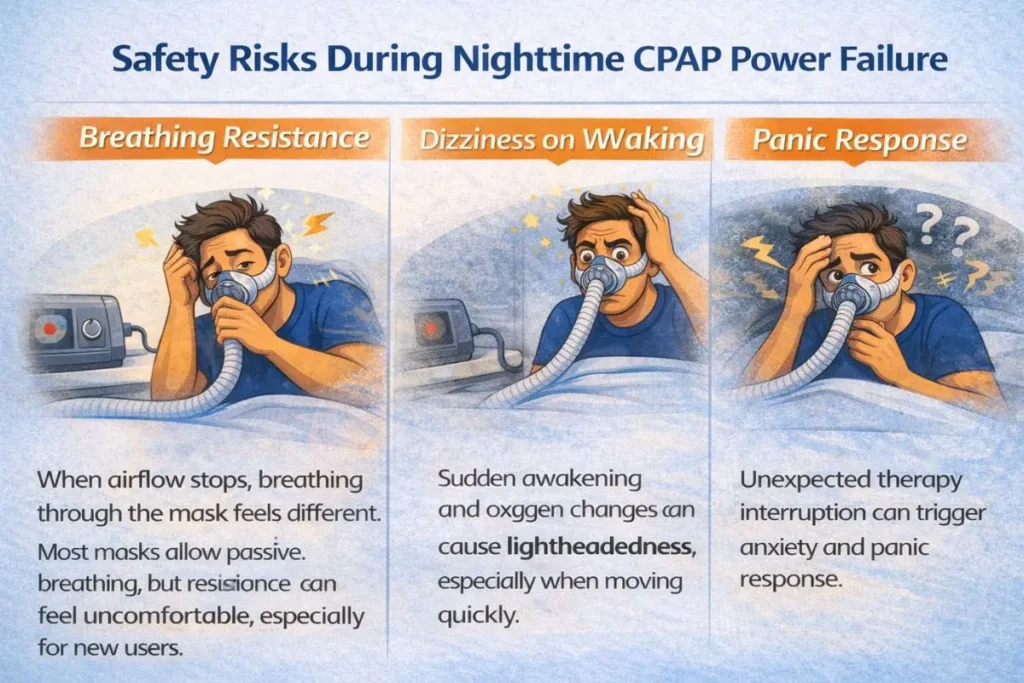
Breathing Resistance

When airflow stops, breathing through the mask feels different. Most masks allow passive breathing, but resistance can feel uncomfortable, especially for new users who are not familiar with that sensation.

This sudden change can lead to confusion, and some users instinctively try to adjust the mask instead of removing it, which prolongs discomfort.

Dizziness on Waking

Sudden awakening, combined with breathing changes and reduced oxygen stability, may cause lightheadedness. This is more noticeable when a person sits up quickly or stands to check equipment.

Taking a moment to stabilize breathing before moving reduces this risk.

Panic Response

Unexpected therapy interruption can trigger anxiety. Waking in darkness without airflow may feel alarming, particularly for people who depend heavily on CPAP therapy.

Understanding beforehand that cpap power failure during sleep can happen helps reduce panic and allows a calmer response.

Safety Risks During Nighttime CPAP Power Failure

How Long Can You Sleep Without CPAP Power?

Short-Term Interruption

A brief interruption may only disturb sleep without causing immediate harm. The body resumes natural breathing patterns, though apnea events may return temporarily.

However, therapy effectiveness is reduced when interruptions happen repeatedly.

Repeated Apnea Events

Longer power interruptions allow untreated apnea episodes to return. Breathing pauses, oxygen drops, and disrupted sleep cycles follow.

For people who experience frequent apnea events, even a single night without therapy can lead to noticeable fatigue and discomfort the next day.

Medical Risk Factors

Individuals with severe sleep apnea, cardiovascular conditions, lung disease, or obesity-related breathing disorders face higher risk. Their bodies rely more heavily on consistent therapy.

For these users, cpap power failure during sleep should be treated as a situation that requires preparation, not something left to chance.

Immediate Safety Steps After CPAP Power Failure

Remove Mask Calmly

The first step is to stay calm and remove the mask slowly. Sudden panic can make breathing feel harder than it is.

Once the mask is removed, breathing usually returns to normal.

Sit Upright

Sitting upright helps open the airway naturally and reduces breathing resistance. This position also helps prevent dizziness.

Check Power Source

After stabilizing breathing, check whether the issue is a local outage, a disconnected cable, or battery depletion.

Understanding the cause helps determine whether therapy can be restarted immediately.

Restart Therapy

If power returns quickly, restart the CPAP and confirm airflow stability before returning to sleep.

If backup power is available, switch calmly and resume therapy.

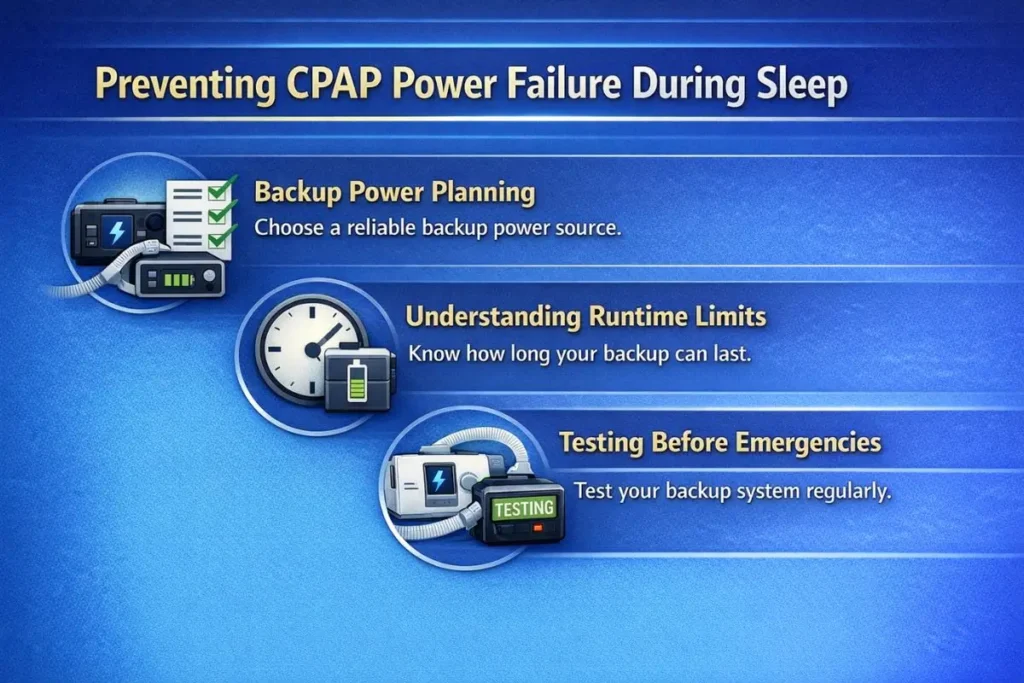
Preventing CPAP Power Failure During Sleep

Backup Power Planning

Reliable backup power reduces the likelihood of therapy interruption. Users in areas with frequent outages benefit most from preparing in advance.

Planning removes uncertainty and allows therapy to continue without disruption.

Understanding Runtime Limits

Backup systems have limits. Knowing how long they can support therapy helps avoid unexpected shutdowns during the night.

This awareness allows users to adjust settings if necessary.

Testing Before Emergencies

Testing backup power during normal conditions provides valuable insight. Users learn how equipment behaves, how long it runs, and whether adjustments are needed.

Testing builds confidence and prevents confusion during real outages.

Preventing CPAP Power Failure During Sleep

Health & Safety Procedures for CPAP Users

Keep Equipment Accessible

Backup cables, batteries, and power sources should be easy to reach. Searching for equipment in the dark increases stress and delays response.

Maintain Clear Airflow Area

Ventilation around both the CPAP machine and power equipment is important. Blocked airflow increases overheating risk.

Monitor Sleep Comfort

Changes in breathing comfort, unusual dryness, or mask discomfort may signal therapy interruption. Paying attention to these signs helps users respond faster.

Discuss Risk With Healthcare Provider

Users with severe apnea or additional health conditions should discuss backup planning with their healthcare provider. Professional guidance helps tailor safety strategies to individual needs.

Understanding personal risk makes preparation more effective and improves overall therapy reliability.

FAQs About CPAP Power Failure During Sleep

Is CPAP power failure during sleep dangerous?

It depends on apnea severity and overall health. Mild cases usually lead to disturbed sleep and fatigue. Moderate to severe apnea may result in oxygen drops, stress responses, and cardiovascular strain. Preparation reduces risk significantly.

Can you suffocate if CPAP stops working?

Most CPAP masks allow passive breathing, so suffocation is unlikely. However, breathing may feel uncomfortable or restricted. The main concern is untreated apnea returning, not lack of oxygen from the mask itself.

How should I respond immediately if my CPAP loses power at night?

Stay calm, remove the mask slowly, sit upright, and stabilize breathing. Then check the power source and restart therapy if possible. Panic makes breathing feel harder than it is.

Who is at highest risk during CPAP power failure?

People with severe sleep apnea, heart disease, lung conditions, obesity-related breathing disorders, and older adults are at higher risk. They benefit most from reliable backup planning.

Why is preparation more important than reacting?

During sleep, awareness is reduced. Preparation ensures therapy continues without panic, confusion, or safety risks.

Should I discuss backup planning with a doctor?

Yes, especially if apnea is severe or if other health conditions exist. Medical guidance helps determine appropriate safety measures.

Final Thoughts

CPAP power failure during sleep is not just an inconvenience. It affects therapy continuity, breathing stability, and overall safety. Understanding what happens and preparing ahead reduces panic and improves response.

Consistent therapy depends on continuous airflow. Continuous airflow depends on reliable power. Planning for cpap power failure during sleep ensures therapy continues even when electricity does not.

Take Care Yourself During Cpap power failure while going to sleep

Related tags:

#cpapbackuppower #cpapbatterybackup #cpappoweroutage #cpappowersafety #portablepowerstationcpap
Categories Uncategorized

CPAP Humidifier Power Usage 2026: How It Affects Battery & Backup Runtime

CPAP Humidifier Power Usage

CPAP humidifier power usage plays a major role in how long a backup battery lasts and how safely therapy continues during outages. Many users assume the airflow motor consumes most electricity, but the humidifier heating system often becomes the largest energy draw during overnight use. Understanding CPAP humidifier power usage helps prevent unexpected shutdowns, unsafe battery planning, and discomfort during therapy interruptions.

Why Humidifiers Change CPAP Power Needs

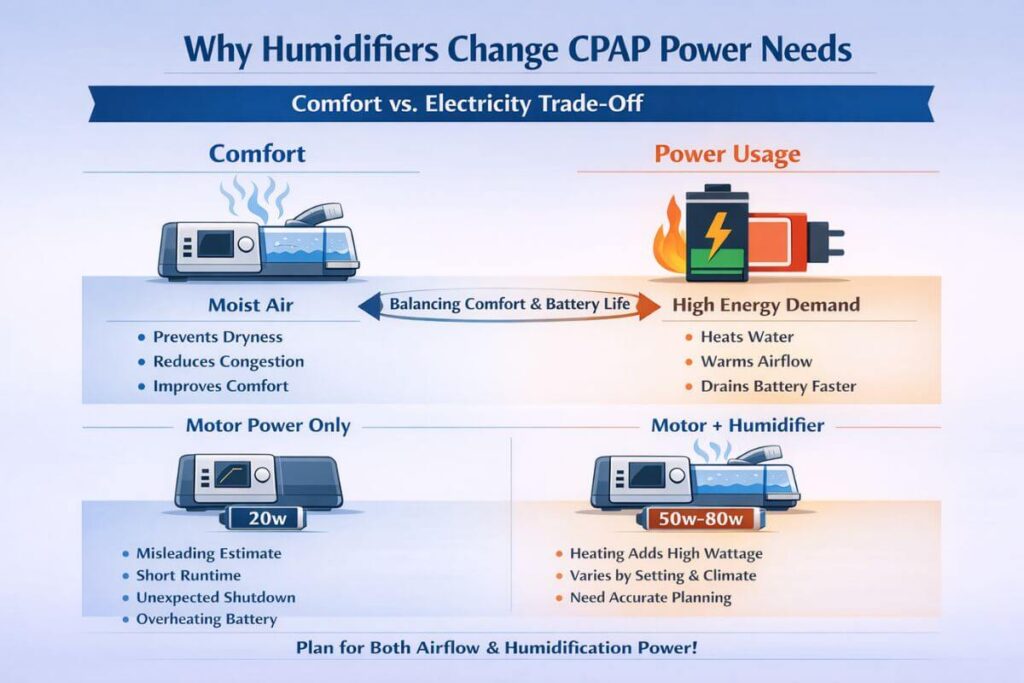
Comfort vs Electricity Trade-Off

Humidification improves comfort by preventing dry air irritation, nasal congestion, and throat dryness. However, increasing humidity requires heating water and sometimes warming the air pathway. This significantly raisesCPAP humidifier electricity consumption, especially when used continuously through the night.

When planning backup power, users must balance comfort and energy demand. Higher humidity settings directly increase CPAP humidifier power usage, which reduces battery runtime.

Why Most Users Underestimate Humidifier Load

Many users calculate battery needs based only on motor wattage. This leads to inaccurate planning. The humidifier often consumes as much or more energy than the airflow system.

Misjudging CPAP humidifier power usage results in:

  • Shorter-than-expected runtime
  • Sudden therapy interruption
  • Battery overheating under load

Accurate planning requires recognizing that CPAP humidifier electricity consumption varies based on settings, climate, and duration.

Why Humidifiers Change CPAP Power Needs

How CPAP Humidifiers Use Electricity

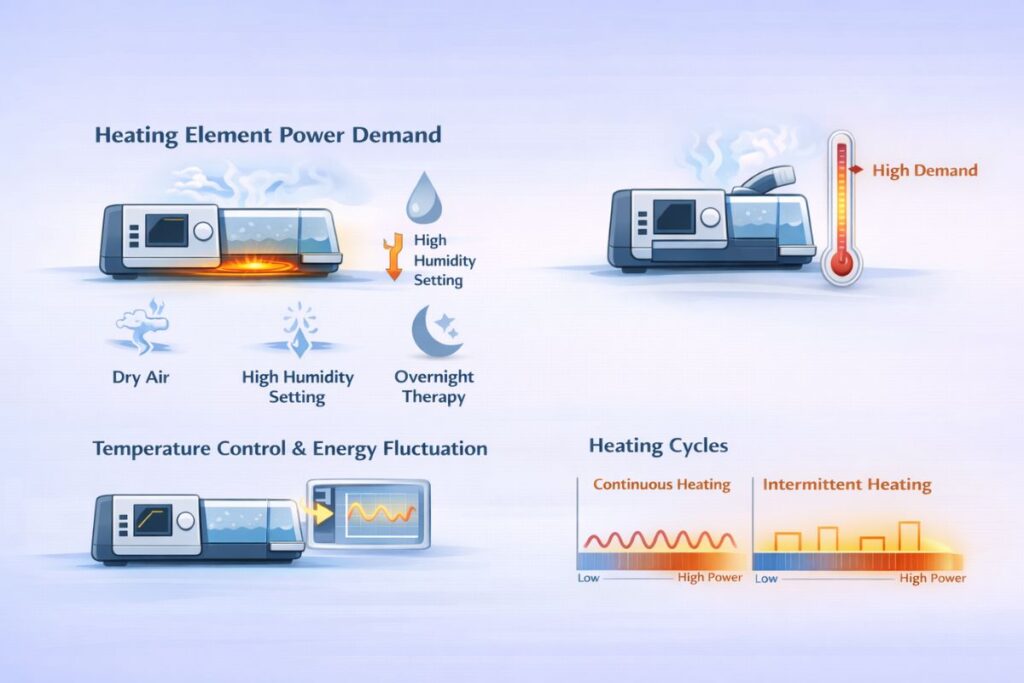
Heating Element Power Demand

The primary source of CPAP humidifier power usage is the heating plate beneath the water chamber. This component warms water to generate moisture and maintain stable humidity levels.

Energy demand increases when:

  • Ambient air is dry
  • Higher humidity settings are selected
  • Therapy runs continuously overnight

Water Temperature Control and Energy Use

Modern systems regulate water temperature to prevent excessive condensation or dryness. This temperature control requires ongoing electrical input.

As the device adjusts heat levels, CPAP humidifier electricity consumption fluctuates rather than remaining constant.

Continuous vs Intermittent Heating Cycles

Some humidifiers maintain steady heat, while others cycle on and off. Continuous heating increases CPAP humidifier power usage, whereas intermittent cycles reduce energy demand but still contribute significantly to total consumption.

How CPAP Humidifiers Use Electricity

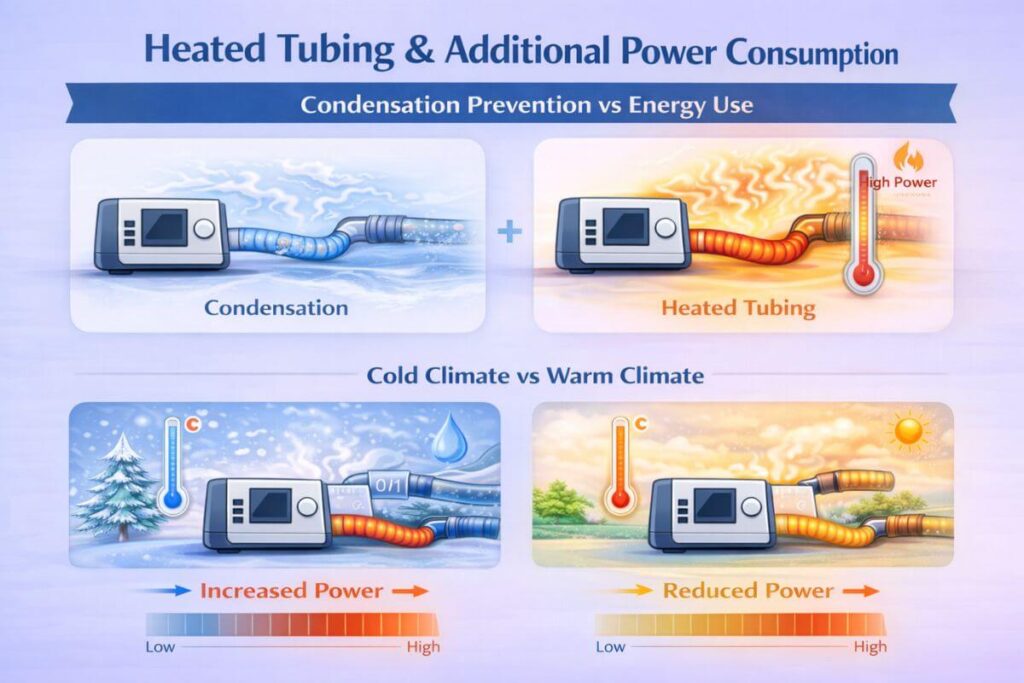
Heated Tubing and Additional Power Consumption

Condensation Prevention vs Energy Use

Heated tubing reduces condensation and maintains comfort, but it adds additional electrical load. CPAP heated tubing power requirements vary based on temperature settings and environmental conditions.

Using heated tubing together with humidification increases overall energy demand.

Cold Climate vs Warm Climate Differences

Environmental temperature directly affects CPAP heated tubing power needs. Cold rooms require more heating to maintain airflow temperature, increasing total consumption.

Warm environments reduce heating demand, lowering combined CPAP humidifier electricity consumption.

Heated Tubing and Additional Power Consumption

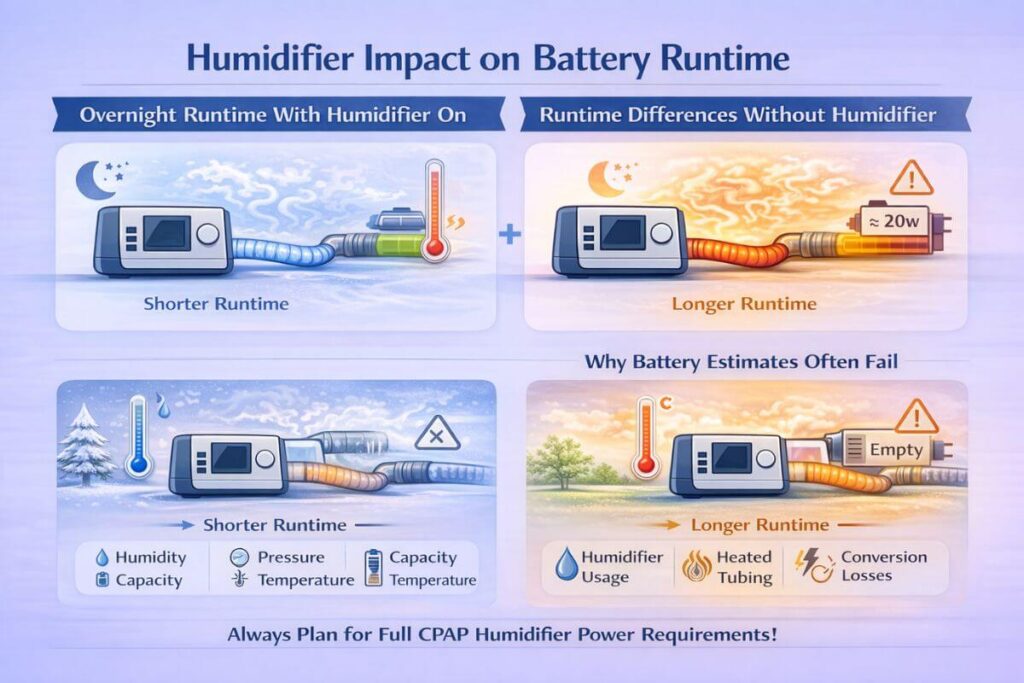
Humidifier Impact on Battery Runtime

Overnight Runtime With Humidifier On

When humidification is active, battery runtime decreases significantly. CPAP battery runtime with humidifier depends on:

  • Humidity setting
  • Therapy pressure
  • Battery capacity
  • Ambient temperature

Even modest humidifier settings can shorten runtime by several hours.

Runtime Differences Without Humidifier

Disabling humidification lowers electrical load. CPAP power without humidifier becomes easier to sustain on limited backup energy.

Many users experience extended runtime when humidification is temporarily reduced during outages.

Why Battery Estimates Often Fail

Battery estimates frequently fail because they exclude humidifier load. Planning based solely on motor wattage leads to unexpected shutdowns.

Accurate calculations must include:

  • CPAP humidifier power usage
  • CPAP heated tubing power
  • Conversion losses
  • Variable heating cycles
Humidifier Impact on Battery Runtime

Practical Calculation: Estimating CPAP Humidifier Power Usage

A simplified approach:

  1. Identify average device wattage without humidifier.
  2. Add estimated humidifier load.
  3. Include heating cycle variability.
  4. Calculate expected runtime conservatively.

Example logic:

  • Base airflow: low-to-moderate wattage
  • Humidifier heating: additional load
  • Heated tubing: extra demand

Total consumption becomes the sum of all active components. Planning must reflect worst-case overnight use.

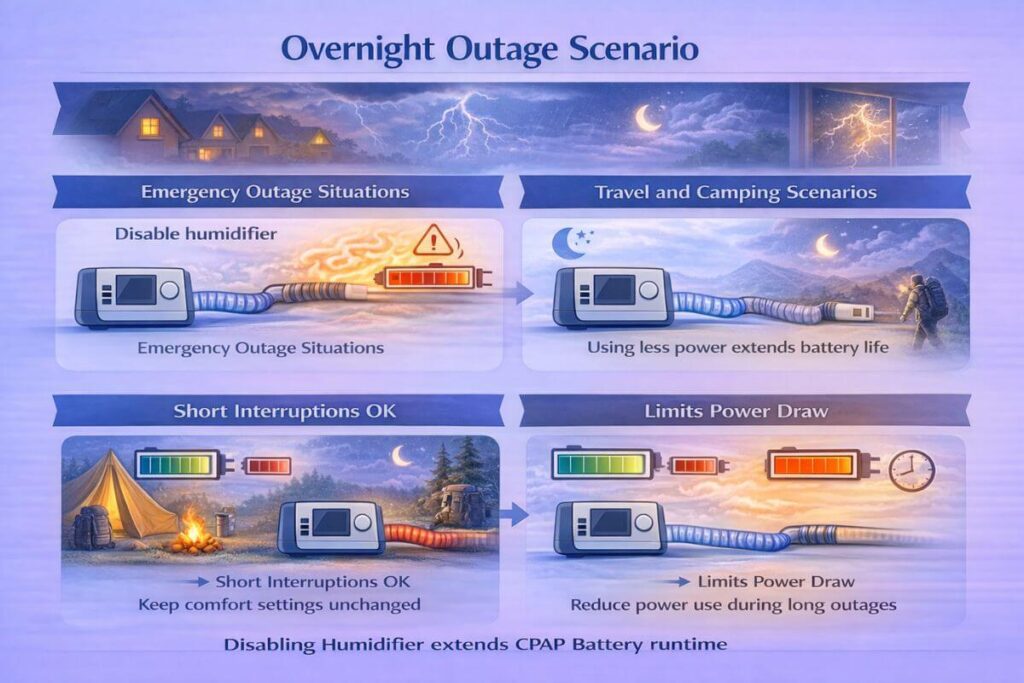
When to Turn Off Humidifier on Backup Power

Overnight Outage Scenario

During a nighttime outage, users may continue sleeping until airflow stops. When backup power activates, the humidifier heating element often begins drawing energy immediately. This increases total demand and reduces available runtime.

In extended outages, lowering humidity settings or temporarily using cpap power without humidifier may help maintain airflow support for a longer period. In these situations, therapy continuity becomes the priority, while comfort adjustments can follow based on need.

Emergency Outage Situations

During outages, disabling humidification may extend battery life and reduce risk of shutdown. This approach improves CPAP battery runtime with humidifier planning by prioritizing airflow continuity.

Travel and Camping Scenarios

Limited charging access requires energy conservation. Many users temporarily reduce CPAP humidifier electricity consumption in these environments.

Short-Term vs Long-Term Use

Short interruptions may not require changes. Extended outages often require adjusting CPAP humidifier power usage to preserve therapy continuity.

When to Turn Off Humidifier on Backup Power

Health & Comfort Considerations

Dryness and Nasal Irritation

Reducing humidity during backup use can lead to noticeable dryness in the nose, throat, and airways. Some users may experience irritation, congestion, or difficulty tolerating airflow when moisture levels are lowered. While this adjustment may help conserve battery power, comfort should not be ignored. If dryness becomes severe, therapy adherence may drop, which can affect overall treatment effectiveness.

Users Who Should Not Disable Humidifier

Not everyone can safely reduce or turn off humidification. Individuals with chronic sinus conditions, nasal inflammation, post-surgical recovery, or respiratory sensitivity often rely on consistent moisture to tolerate CPAP therapy. In these cases, changes to humidification should be made cautiously and ideally with medical input.

Medical Guidance vs Personal Adjustment

Humidifier settings are part of therapy comfort and effectiveness. Any major adjustment—especially during outages or battery use—should consider both medical guidance and real-world tolerance. Planning around cpap humidifier power usage should focus on maintaining therapy continuity while minimizing discomfort.

Safety Note on Backup Planning

Many users assume humidifier settings can remain unchanged during outages. In reality, CPAP humidifier power usage must be treated as a variable load. Heating demand increases with cold environments, high humidity settings, and longer therapy duration.

Testing real conditions is essential. Backup planning should never rely on estimated numbers alone. Including CPAP battery runtime with humidifier testing helps prevent sudden therapy interruption and improves safety planning.

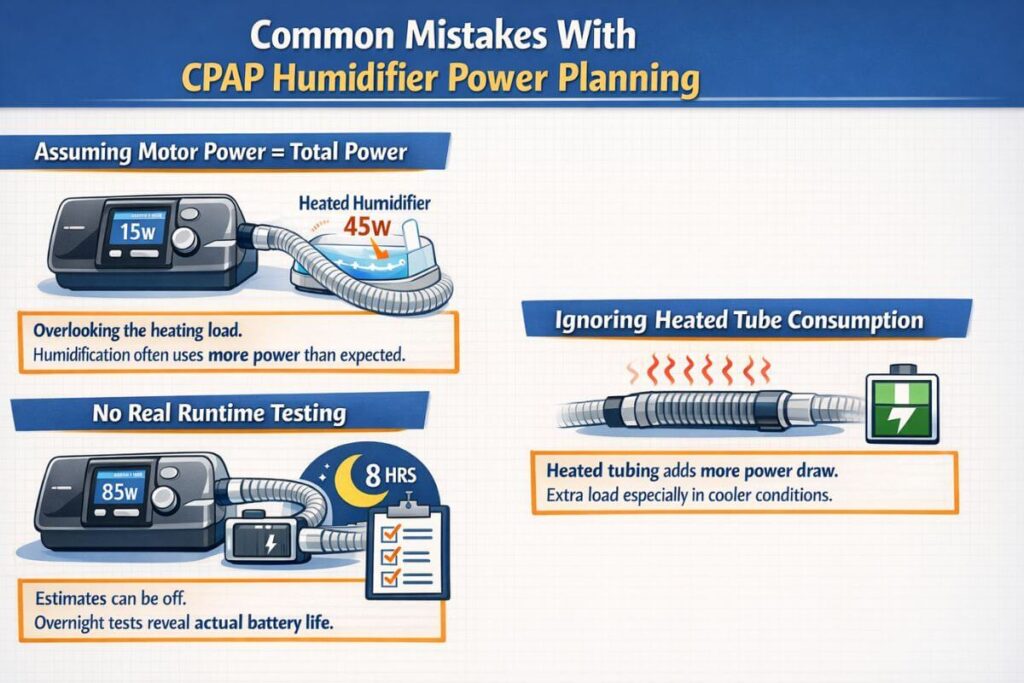
Common Mistakes With CPAP Humidifier Power Planning

Assuming Motor Power = Total Power

Many users estimate power needs based only on airflow motor consumption. This overlooks the heating load created by humidification. In reality, cpap humidifier electricity consumption often accounts for a large portion of total overnight energy use, which directly affects backup runtime.

Ignoring Heated Tube Consumption

Heated tubing adds an additional electrical load that is frequently underestimated. Cpap heated tubing power increases total demand, particularly in cooler environments where condensation prevention requires continuous heating.

No Real Runtime Testing

Battery estimates based on theoretical numbers are often inaccurate. Actual overnight testing is the most reliable way to understand real cpap humidifier electricity consumption and prepare for outages. Testing helps identify how long therapy can run safely with current humidifier settings.

Common Mistakes With CPAP Humidifier Power Planning

FAQs About CPAP Humidifier Power

Does humidifier double CPAP power usage?

Not always, but it can significantly increase total electricity demand. The airflow motor and humidifier heating element operate separately, and when both run continuously, overall CPAP humidifier power usage rises quickly. The exact increase depends on humidity level, room temperature, and duration of therapy.

Can CPAP run safely without humidifier overnight?

For many users, short-term use without humidification is possible. Airflow therapy continues normally, but dryness, throat irritation, or nasal discomfort may occur. Individuals with chronic sinus sensitivity or respiratory irritation should be cautious before disabling humidification.

Does humidity level change electricity use?

Yes. Higher humidity settings require more heating energy, which increases CPAP humidifier electricity consumption. Lower settings reduce load and may extend battery runtime, especially during outages.

How much battery runtime is lost with humidifier on?

Battery duration varies widely, but CPAP battery runtime with humidifier is typically shorter than when the humidifier is off. The heating element continuously draws power, which reduces total available runtime overnight.

Is heated tubing necessary for all users?

No. CPAP heated tubing power is most useful in colder environments where condensation is likely. In warm climates, tubing heat may be reduced or unnecessary, lowering total electricity demand.

Can backup planning ignore humidifier load?

No. Ignoring CPAP humidifier power usage results in inaccurate runtime estimates. Backup planning must include airflow motor, humidifier heating, and tubing energy use.

Why does battery drain faster in cold weather?

Cold environments increase heating demand. Both humidifier and tubing require more energy to maintain moisture and temperature, raising total CPAP humidifier electricity consumption and reducing battery runtime.

Does water level affect humidifier electricity usage?

Indirectly, yes. When water temperature drops due to evaporation, the heating element works harder to maintain humidity. This increases CPAP humidifier power usage over time.

Should humidifier always be turned off during outages?

Not necessarily. Comfort and medical needs must be considered. Some users may tolerate lower humidity, while others require it to prevent irritation. Backup planning should evaluate both safety and comfort.

How often should runtime testing be done?

Testing should be performed periodically, especially after battery replacement, seasonal changes, or equipment adjustments. Real-world testing reveals true CPAP humidifier electricity consumption and helps avoid unexpected shutdowns.

Do all CPAP models use similar humidifier power?

No. Heating efficiency, control systems, and design vary between devices. CPAP humidifier electricity consumption differs depending on configuration and usage patterns.

Is it safer to reduce humidifier before battery runs low?

Reducing humidity early can extend therapy runtime. Lower CPAP humidifier power usage helps maintain airflow continuity during prolonged outages.

What is the safest way to plan humidifier use with backup power?

Start with conservative estimates. Test real settings overnight, monitor power draw, and plan for worst-case conditions. Accurate understanding of CPAP humidifier power usage ensures safe and reliable therapy continuity.

Practical Observation From Real Use

Many users only recognize the impact of cpap humidifier electricity consumption after noticing reduced battery runtime during travel or power interruptions. Testing backup setups in advance and adjusting humidification gradually can improve both safety and comfort.

Understanding how cpap humidifier power usage behaves in real conditions helps users make informed decisions about battery planning, therapy adjustments, and overnight preparedness.

Related tags:

#cpapbackuppower #cpapbatterybackup #cpappoweroutage #cpappowersafety #portablepowerstationcpap
Categories Uncategorized

CPAP Power Consumption Guide: How Much Electricity Does a CPAP Use at Night?

CPAP Power Consumption Guide

CPAP power consumption becomes part of your therapy the moment you begin using a CPAP machine every night, whether you actively think about it or not. Many people only start paying attention to it when they travel, experience power outages, or begin planning a backup setup — and that’s usually when uncertainty about electricity needs and runtime first appears..

CPAP machines are not high-energy devices compared to appliances, but they run continuously for hours. That overnight operation changes how power needs should be calculated. Understanding CPAP power consumption helps you avoid guesswork and prepare realistically for outages or battery use.

Why CPAP Power Consumption Matters

CPAP therapy works because airflow stays consistent while you sleep. The moment power stops, therapy stops. That makes electricity part of the treatment itself, not just a convenience.

Many users assume a CPAP uses very little power and any battery will work. Others overestimate and buy unnecessarily large systems. Both mistakes come from not understanding how power usage actually works.

Planning starts with one simple idea:
You don’t need exact numbers. You need realistic ranges.

Why CPAP Power Consumption Matters

Average CPAP Power Consumption

Most CPAP machines operate efficiently, but actual consumption varies more than people expect.

Typical Usage Levels

Basic CPAP units without heating features draw modest electricity during steady operation. The airflow motor is designed for efficiency. However, that’s only part of the picture.

The moment comfort features are enabled, power use increases.

APAP vs CPAP vs BiPAP

Different therapy types change electrical demand:

  • CPAP: consistent pressure, steady usage
  • APAP: adjusts pressure, usage varies throughout the night
  • BiPAP: dual pressure delivery, typically higher demand

Auto-adjusting systems respond to breathing patterns, which means power draw isn’t always constant.

Why Real Usage Differs From Specifications

Manufacturer numbers come from controlled conditions. Real-life use includes:

  • mask leaks
  • room temperature changes
  • pressure fluctuations
  • humidifier activity

These factors shift consumption from “ideal” to “practical.”

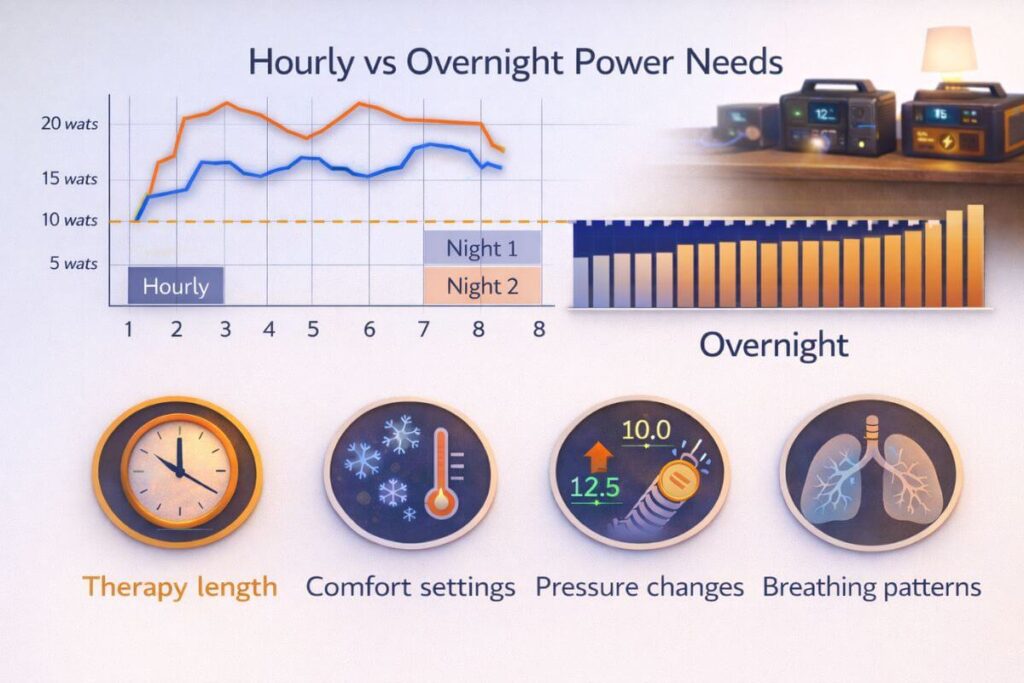
CPAP Wattage Per Night

People often ask how much electricity a CPAP uses in a single night. The answer depends on duration and configuration.

Hourly vs Overnight Thinking

Looking at hourly consumption doesn’t help much. What matters is how that adds up across an entire sleep cycle. A small hourly draw becomes significant when multiplied by six to eight hours.

What Changes Nightly Power Needs

Nightly usage isn’t identical every time. It shifts based on:

  • therapy length
  • comfort settings
  • pressure changes
  • breathing patterns

Two nights with the same machine can still produce different consumption levels.

CPAP Wattage Per Night

CPAP Humidifier Power Usage

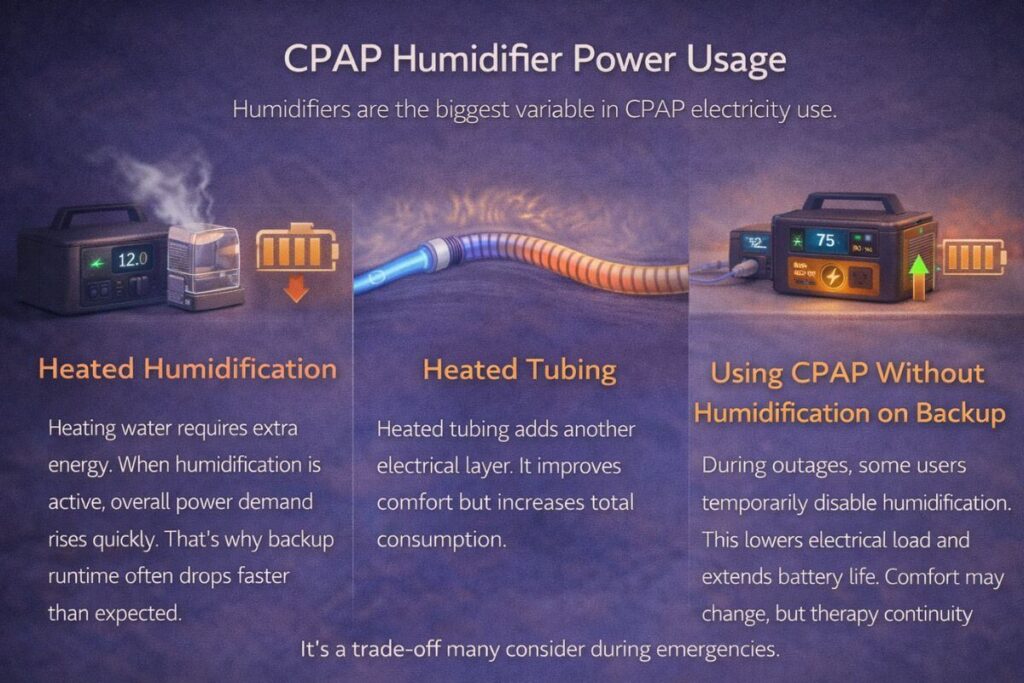
Humidifiers are the biggest variable in CPAP electricity use.

Heated Humidification

Heating water requires extra energy. When humidification is active, overall power demand rises quickly. That’s why backup runtime often drops faster than expected.

Heated Tubing

Heated tubing adds another electrical layer. It improves comfort but increases total consumption.

Using CPAP Without Humidification on Backup

During outages, some users temporarily disable humidification. This lowers electrical load and extends battery life. Comfort may change, but therapy continuity improves.

It’s a trade-off many consider during emergencies

CPAP Humidifier Power Usage

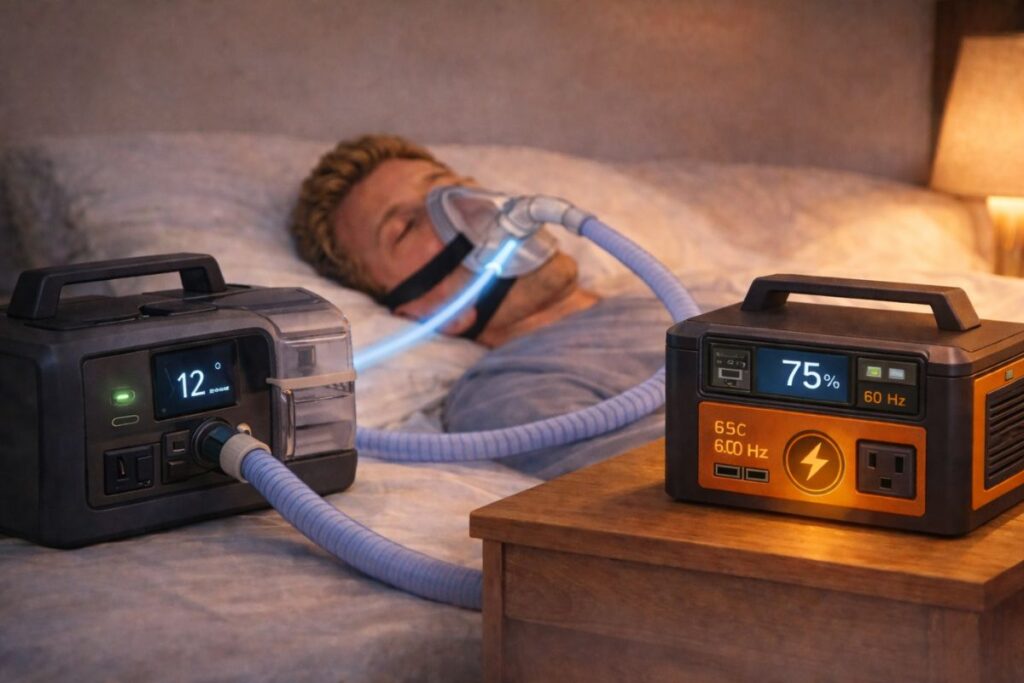
How Much Power Does a CPAP Use on Battery?

When batteries enter the picture, the conversation changes from electricity use to energy storage.

Watts vs Energy Storage

Watts describe how fast power is used. Stored energy determines how long a device can run.

A low-power device can still drain a small battery if it runs all night.

Estimating Runtime

Battery runtime depends on:

  • device power draw
  • battery capacity
  • efficiency losses
  • active features

There’s no universal runtime figure because setups differ.

Why Testing Beats Guessing

Testing a CPAP with a backup power source reveals:

  • real runtime
  • heat behavior
  • compatibility issues

That information is far more useful than theoretical estimates.

CPAP Battery Runtime Planning

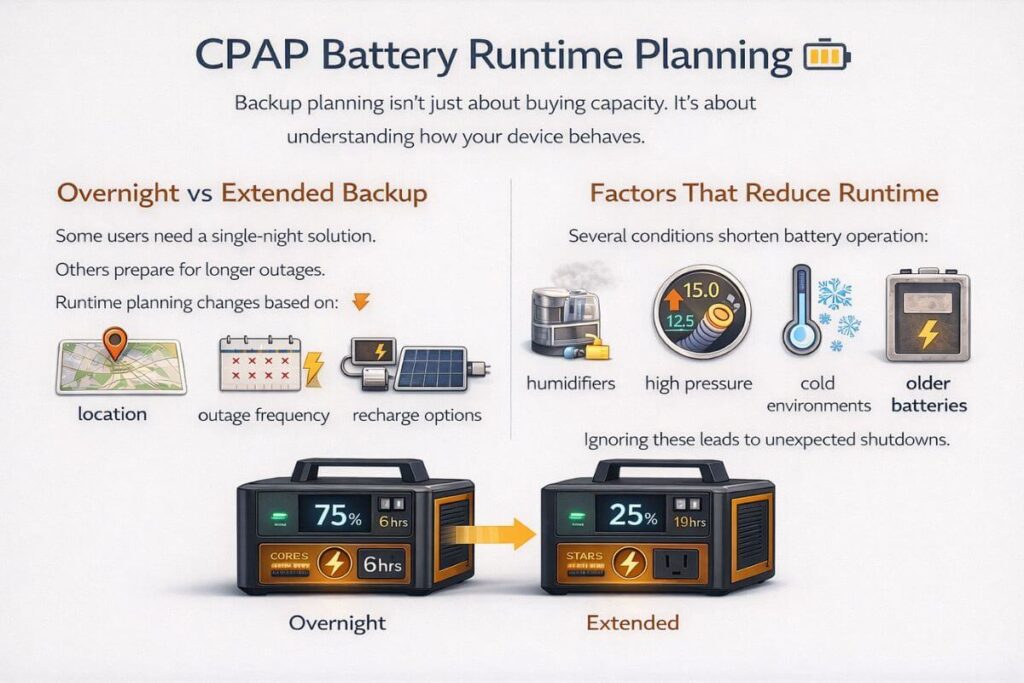
Backup planning isn’t just about buying capacity. It’s about understanding how your device behaves.

Overnight vs Extended Backup

Some users need a single-night solution. Others prepare for longer outages. Runtime planning changes based on:

  • location
  • outage frequency
  • recharge options

Factors That Reduce Runtime

Several conditions shorten battery operation:

  • humidifiers
  • high pressure
  • cold environments
  • older batteries

Ignoring these leads to unexpected shutdowns.

CPAP Battery Runtime Planning

Common Mistakes When Estimating CPAP Power Needs

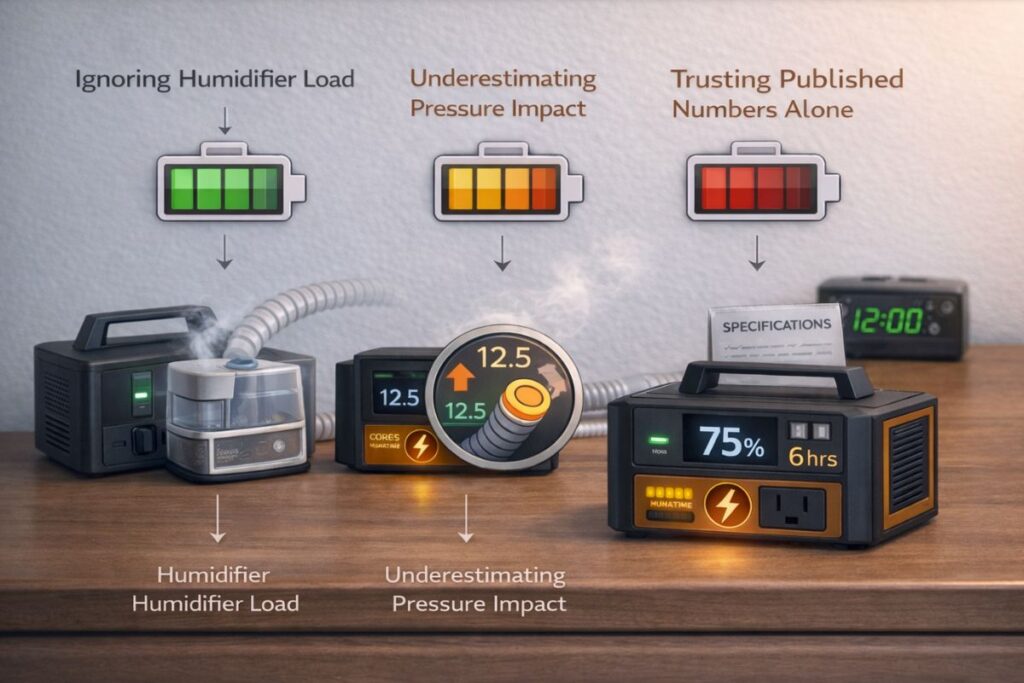
Most problems don’t come from equipment failure. They come from assumptions.

Ignoring Humidifier Load

Users often calculate airflow motor usage only. Humidifiers can significantly increase total demand.

Underestimating Pressure Impact

Higher therapy pressure requires more motor work, especially in auto-adjusting systems.

Trusting Published Numbers Alone

Manufacturer ratings don’t reflect personal use patterns. Real-world conditions always vary.

Understanding CPAP power safety is essential before planning any backup setup.

Common Mistakes When Estimating CPAP Power Needs

FAQs About CPAP Power Consumption and Electricity Use

1) How much power does a CPAP machine actually use per night?

A CPAP machine’s nightly electricity use depends on how long it runs and which features are enabled. The airflow motor alone is relatively efficient, but overnight therapy means the device operates continuously for several hours. When humidification, heated tubing, or higher pressure settings are added, total consumption increases.

Instead of focusing on a single number, it is better to think in ranges. A basic setup without heating features uses less power and is easier to support with backup systems. A fully configured setup with humidification and higher therapy pressure requires more planning. The difference between these two scenarios can be significant across a full night.

Real usage varies between individuals, so testing the device under normal sleep conditions gives the most accurate estimate of nightly consumption.

2) Does a CPAP machine use a lot of electricity compared to other home devices?

Compared to appliances like refrigerators, heaters, or microwaves, CPAP machines use relatively modest electricity. However, the comparison changes because CPAP therapy runs continuously overnight rather than in short bursts.

The consistent operation is what makes power planning important. Even moderate electricity use becomes meaningful when multiplied across several hours every night. Over time, this steady consumption adds up, especially when comfort features are active.

From a household perspective, CPAP power use is manageable. From a therapy perspective, it must be reliable.

3) How does a humidifier change CPAP power consumption?

Humidifiers are one of the biggest factors affecting electricity use. Heating water requires additional energy, and when humidification runs throughout the night, overall consumption rises noticeably.

Heated tubing also adds to this load. While both features improve comfort, they increase demand on power sources and reduce battery runtime during outages. This is why many users temporarily reduce humidification when operating on backup power.

The change in comfort is often acceptable for short periods if it allows therapy to continue uninterrupted.

4) Can a battery realistically run a CPAP overnight?

Yes, many batteries can support overnight CPAP use, but the outcome depends on device settings and battery capacity. Runtime varies widely depending on pressure level, humidifier use, and overall efficiency.

Some users find that their backup system runs the CPAP comfortably through the night. Others discover it lasts fewer hours than expected. The difference usually comes from assumptions made before testing.

Running the CPAP on backup power in advance reveals realistic runtime expectations and helps avoid surprises during an actual outage.

5) Why do two CPAP users get different power results with the same machine?

Even when two people use identical devices, their power consumption can differ due to therapy settings and sleep conditions. Pressure levels, humidification, tubing heat, and duration of use all influence electricity demand.

Environmental factors also matter. Room temperature, mask fit, and airflow resistance change how hard the motor works. Over time, equipment aging can also affect efficiency.

Because of these variables, personal testing provides more reliable insight than general estimates.

6) Is it safe to run a CPAP without humidification during power outages?

For many users, running a CPAP without humidification for short periods is acceptable. Comfort may decrease, and some dryness may occur, but therapy can continue. Reducing humidifier use lowers electricity demand and extends battery runtime.

However, users who rely heavily on humidification for nasal comfort or medical reasons should consult their provider before making changes. Each situation is different, and comfort requirements vary.

The decision often comes down to balancing comfort with continuity during temporary power loss.

7) What is the most common mistake people make when planning CPAP power use?

The most common mistake is underestimating how settings affect consumption. Many users assume airflow motor usage alone determines electricity needs and forget about humidifiers, pressure adjustments, and runtime variability.

Another frequent issue is relying entirely on manufacturer specifications without testing real usage. Those numbers provide a starting point but don’t reflect personal therapy patterns.

Planning based on real conditions — not assumptions — is what leads to reliable backup setups and consistent therapy.

Final Thoughts

CPAP machines don’t require huge amounts of electricity, but they rely on stability. Overnight use means small power differences add up. Comfort features, therapy pressure, and runtime all shape real consumption.

Understanding how much power your CPAP uses removes uncertainty. It allows you to plan backup realistically, avoid overbuying equipment, and prevent therapy interruptions.

Reliable therapy starts with consistent airflow. Consistent airflow starts with stable power.

related tags:

#cpapbackuppower #cpapbatterybackup #cpappoweroutage #cpappowersafety #portablepowerstationcpap
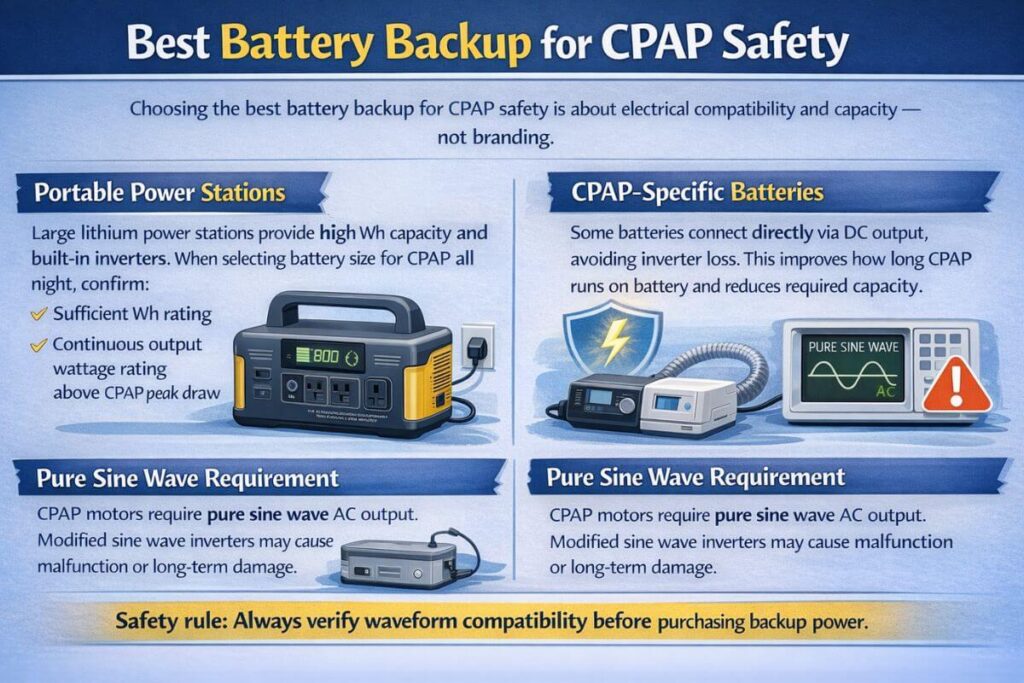
Categories Uncategorized

CPAP Power Station Safety Guidelines 2026: What You Must Know Before Using Backup Power

CPAP Power Station Safety Guidelines 2026

Power interruptions are not a minor inconvenience for people who rely on CPAP therapy. A CPAP machine is designed to deliver continuous airflow during sleep, and any disruption in power directly interferes with treatment. When backup power is poorly planned or unsafe, the risks extend beyond discomfort into real health and safety concerns.

These CPAP power station safety guidelines are written to help users understand what can go wrong, why it happens, and how to reduce risk when using a portable power station as a backup power source. This is not a product review and not sales advice. The focus is safety, reliability, and realistic use during power outages.

Why CPAP Power Station Safety Matters

A CPAP machine is not comparable to a lamp, fan, or phone charger. Its function is to prevent airway collapse while the user is asleep. During sleep, muscle tone decreases, awareness is reduced, and the body depends entirely on the machine to maintain breathing.

Because of this, CPAP devices are engineered to operate on stable, uninterrupted electrical power. Voltage fluctuations, waveform distortion, or sudden shutdowns are not neutral events. They directly interrupt therapy.

For users with moderate to severe sleep apnea, heart disease, lung conditions, or neurological disorders, CPAP power continuity should be treated as a medical safety issue, not an optional upgrade.

Why CPAP Power Station Safety Matters

What Happens If a CPAP Loses Power During Sleep

Understanding the real sequence of events during a power loss helps explain why backup planning is important.

When power is interrupted, airflow stops immediately. There is no gradual reduction. The response varies from person to person:

  • Some users wake quickly due to airflow changes or mask pressure shifts
  • Others remain asleep for several seconds or longer, depending on sleep depth
  • Auto-adjusting machines have no fallback mode without power

For many users, waking up involves confusion, a sensation of air hunger, or panic. While most masks allow passive exhalation, breathing without pressurized airflow can feel unfamiliar and distressing.

Health Risks by Apnea Severity

The impact of power loss is not the same for everyone:

  • Mild sleep apnea: Often results in disrupted sleep and discomfort
  • Moderate sleep apnea: Apneas resume quickly, increasing oxygen drops and stress response
  • Severe sleep apnea: Oxygen desaturation can occur rapidly, especially during REM sleep

People with severe apnea, cardiac arrhythmias, prior stroke, or chronic lung disease should consider overnight CPAP power loss a higher-risk scenario.

Why Waking Up Isn’t Always Immediate

It is a misconception that loss of airflow always wakes the user instantly. Factors that delay awareness include:

  • Deep sleep stages
  • Alcohol consumption
  • Sleep medications
  • Neurological or cognitive conditions

Delayed awakening increases the duration of untreated apnea events. Sudden awakening can also cause dizziness or disorientation, especially when trying to troubleshoot power in the dark.

What Happens If a CPAP Loses Power

Understanding CPAP Power Requirements Before Using a Power Station

Safe backup planning starts with knowing how CPAP machines actually consume power.

Typical CPAP Power Consumption

Most CPAP machines draw relatively modest power during steady operation. However, actual consumption depends on several variables:

  • Pressure settings
  • Therapy mode (CPAP, APAP, BiPAP)
  • Heated humidifier use
  • Heated tubing

Humidification and tubing heat can significantly increase power draw and shorten backup runtime.

Why Published Wattage Numbers Can Be Misleading

Manufacturer specifications are often measured under controlled conditions. Real-world use differs due to:

  • Ambient temperature
  • Mask leaks
  • Pressure variability
  • Aging components

Relying only on published wattage numbers without testing real usage can lead to insufficient backup capacity during an outage.

Critical CPAP Power Station Safety Guidelines

This section addresses the most common and serious safety issues seen in CPAP backup setups.

Use Only Pure Sine Wave Power

CPAP machines contain sensitive electronics and motor controllers designed for clean AC power. A portable power station used for CPAP must provide pure sine wave output.

Pure sine wave power helps ensure:

  • Stable motor operation
  • Reduced electrical noise
  • Lower heat buildup
  • Long-term device reliability

From a safety standpoint, this is not optional.

Avoid Modified Sine Wave and Cheap Inverters
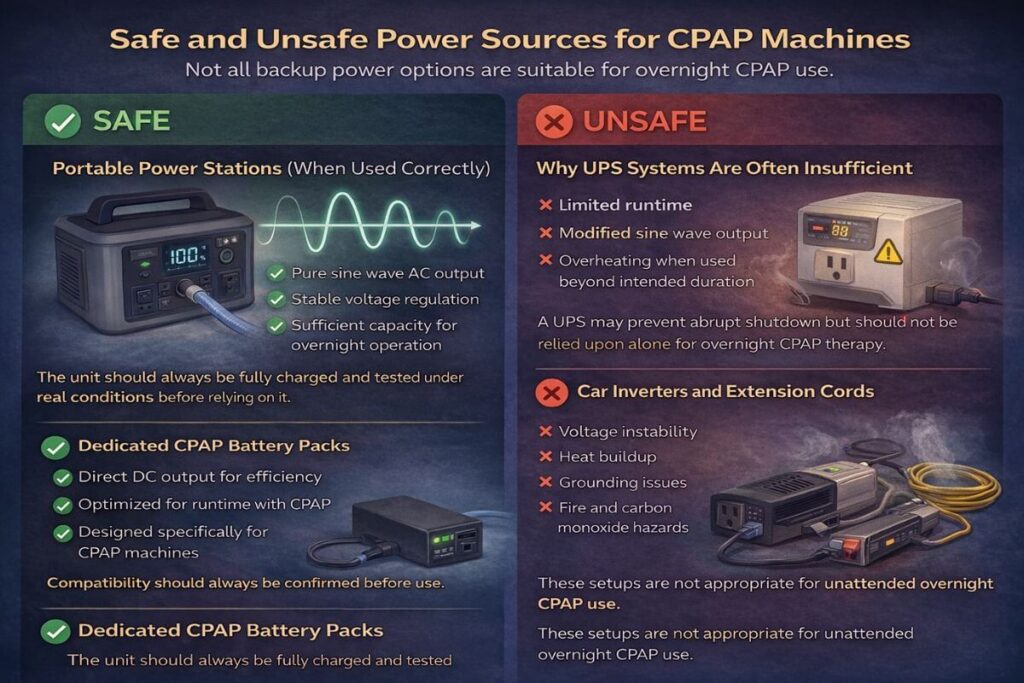
Modified sine wave output may allow a CPAP machine to turn on, but that does not mean it is operating safely. Common issues include:

  • Audible buzzing or vibration
  • Increased heat in the power supply
  • Erratic behavior or unexpected shutdowns

These effects may not appear immediately but can damage the device over time. For medical equipment, “it seems to work” is not a safe standard.

Critical CPAP Power Station Safety Guidelines

CPAP Humidifier Power Safety Considerations

Heated humidifiers increase comfort but also increase electrical risk.

Key points to understand:

  • Humidifiers significantly increase power draw
  • Poor power quality can cause overheating
  • Water and electricity are in close proximity

During outages, many users reduce or disable humidification to improve safety and extend runtime. While comfort may decrease, electrical stability often improves.

Users with chronic nasal issues should weigh comfort against safety and consult their healthcare provider if unsure.

Safe and Unsafe Power Sources for CPAP Machines

Not all backup power options are suitable for overnight CPAP use.
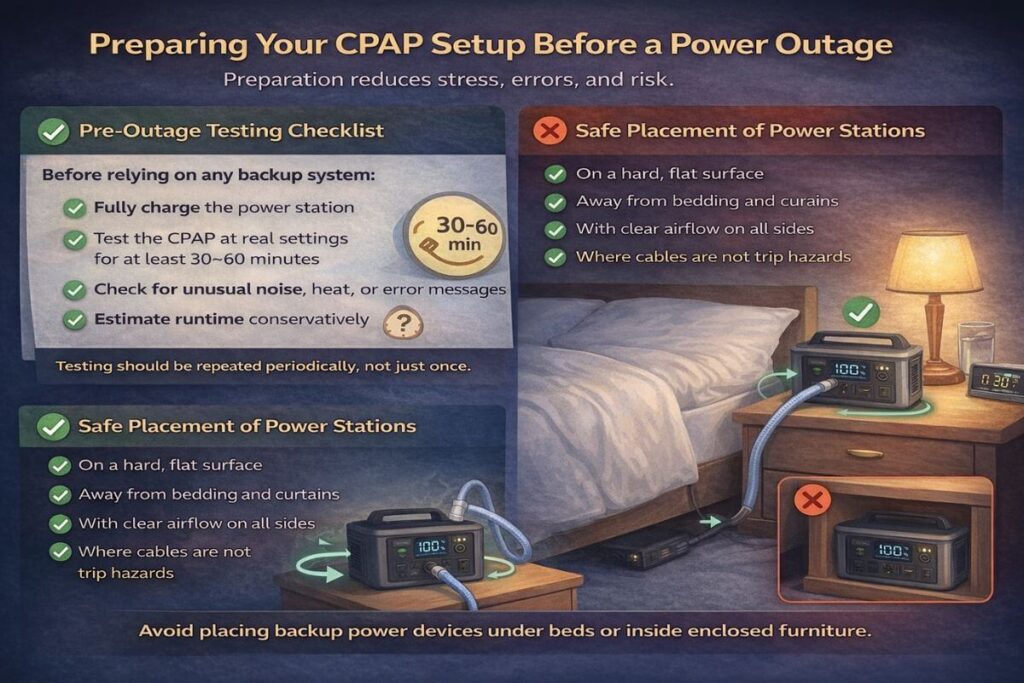
Portable Power Stations (When Used Correctly)

A portable power station can be safe for CPAP use if it provides:

  • Pure sine wave AC output
  • Stable voltage regulation
  • Sufficient capacity for overnight operation
  • Adequate ventilation

The unit should always be fully charged and tested under real conditions before relying on it.

Dedicated CPAP Battery Packs

Battery packs designed specifically for CPAP use often provide direct DC output, reducing conversion losses. They are typically optimized for runtime but may have limited flexibility or humidifier support.

Compatibility should always be confirmed before use.

Why UPS Systems Are Often Insufficient

Uninterruptible Power Supplies are designed for short-term bridging, not sustained overnight medical operation. Limitations include:

  • Limited runtime
  • Modified sine wave output
  • Overheating when used beyond intended duration

A UPS may prevent abrupt shutdown but should not be relied upon alone for overnight CPAP therapy.

Car Inverters and Extension Cords

Vehicle inverters and long extension cords introduce multiple risks:

  • Voltage instability
  • Heat buildup
  • Grounding issues
  • Fire and carbon monoxide hazards

These setups are not appropriate for unattended overnight CPAP use.

Safe and Unsafe Power Sources for CPAP Machines

Preparing Your CPAP Setup Before a Power Outage

Preparation reduces stress, errors, and risk.

Pre-Outage Testing Checklist

Before relying on any backup system:

  • Fully charge the power station
  • Test the CPAP at real settings for at least 30–60 minutes
  • Check for unusual noise, heat, or error messages
  • Estimate runtime conservatively

Testing should be repeated periodically, not just once.

Safe Placement of Power Stations

Power stations should be placed:

  • On a hard, flat surface
  • Away from bedding and curtains
  • With clear airflow on all sides
  • Where cables are not trip hazards

Avoid placing backup power devices under beds or inside enclosed furniture.

Preparing Your CPAP Setup Before a Power Outage

Common CPAP Backup Power Mistakes

Many problems occur due to incorrect assumptions rather than lack of equipment.

Underestimating Runtime Needs

Planning for a few hours instead of a full night often results in power loss during early morning sleep cycles, when awareness may be lowest.

Ignoring Power Quality

Battery capacity alone does not guarantee safety. Clean, stable power is essential for medical electronics.

Using Untested Equipment

The first use of backup power should never be during an actual outage. Discovering incompatibility at 2 a.m. is a safety risk.

When a Larger CPAP Backup Power Solution Is Needed

Backup requirements vary based on lifestyle and outage patterns.

  • Frequent outages may require higher-capacity solutions
  • Multi-day outages require recharging strategies and reduced power use
  • Travel, camping, and disaster scenarios introduce additional risks

Each scenario should be evaluated separately, with conservative assumptions.

Frequently Asked Questions About CPAP Power Station Safety

Is it safe to run a CPAP without a humidifier?
For many users, yes, especially short-term. Comfort may decrease, but safety and runtime often improve.

Can solar panels power a CPAP machine safely?
Solar panels can recharge batteries or power stations, but direct operation requires stable regulation and sufficient storage.

How long can a CPAP run on a portable power station?
Runtime depends on battery capacity, power draw, and settings. Testing under real conditions is the only reliable method.

Is a UPS enough for overnight CPAP use?
In most cases, no. UPS systems are not designed for sustained overnight medical operation.

Final Notes on CPAP Power Station Safety Guidelines

CPAP therapy depends on consistency and reliability. Backup power planning is not about convenience. It is about ensuring therapy continues safely when normal power is unavailable. Understanding CPAP power station safety guidelines allows users to make informed decisions and reduce avoidable risks.

Final Notes on CPAP Power Station Safety Guidelines