
If you’re wondering about the battery size for CPAP all night, you’re not alone. A sudden power outage can interrupt therapy, compromise sleep quality, and even trigger serious health risks. Guessing your backup power needs is dangerous. The solution? Accurate calculations, realistic safety buffers, and informed planning. This guide walks you through everything — from CPAP power consumption per night to real-world battery math — so you can protect your therapy with confidence.
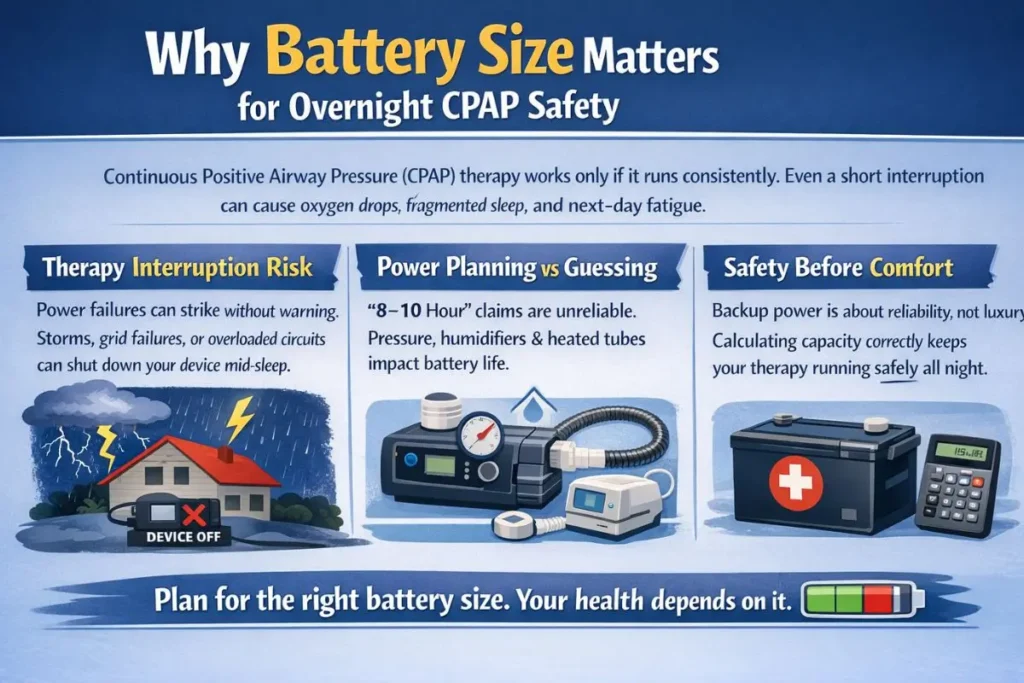
Why Battery Size Matters for Overnight CPAP Safety
Continuous Positive Airway Pressure (CPAP) therapy works only if it runs consistently. Even a short interruption can cause oxygen drops, fragmented sleep, and next-day fatigue. For people with moderate to severe sleep apnea, therapy interruption risk is more than discomfort — it can increase cardiovascular strain.
Therapy Interruption Risk
Power failures rarely come with warnings. Storms, grid failures, or overloaded circuits can shut down your device mid-sleep. Without the correct battery size for CPAP all night, your therapy may stop unexpectedly.
Power Planning vs Guessing
Many users rely on vague “8–10 hour runtime” claims. But every setup is different. Pressure levels, humidifiers, tubing heat, and inverter efficiency all impact how long CPAP runs on battery.
Safety Before Comfort
Backup power isn’t about luxury — it’s about medical reliability. Planning your CPAP battery capacity calculation properly ensures your therapy continues safely through the night.
CPAP Power Consumption Per Night
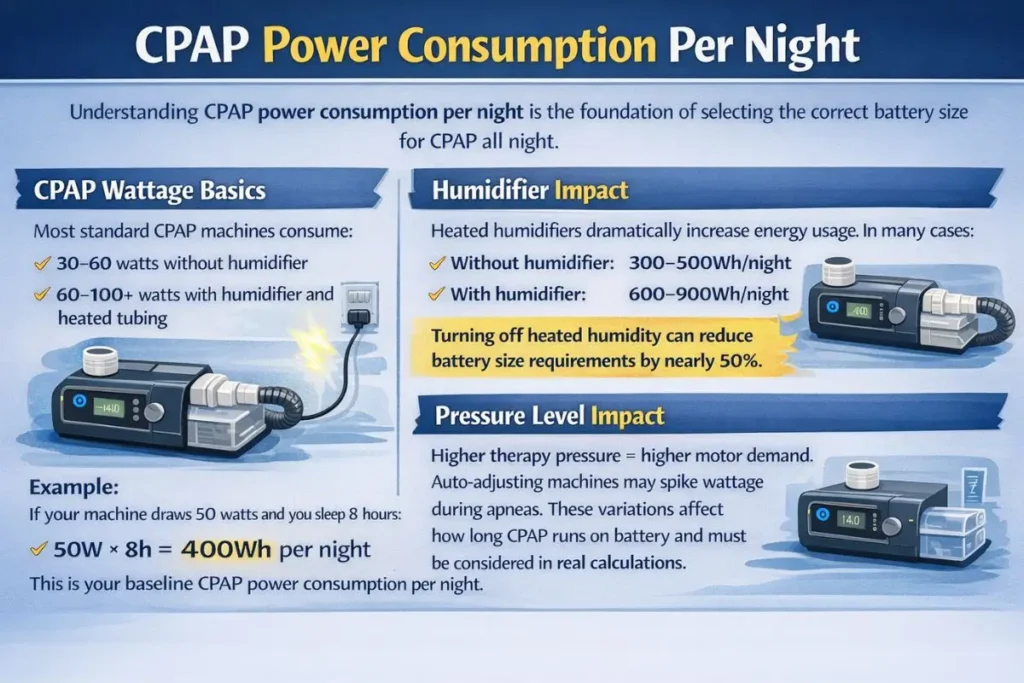
Understanding CPAP power consumption per night is the foundation of selecting the correct battery size for CPAP all night.
CPAP Wattage Basics
Most standard CPAP machines consume:
- 30–60 watts without humidifier
- 60–100+ watts with humidifier and heated tubing
To estimate nightly usage:
Watts × Hours = Watt-Hours (Wh)
Example:
If your machine draws 50 watts and you sleep 8 hours:
50W × 8h = 400Wh per night
This is your baseline CPAP power consumption per night.
Humidifier Impact
Heated humidifiers dramatically increase energy usage. In many cases:
- Without humidifier: 300–500Wh/night
- With humidifier: 600–900Wh/night
Turning off heated humidity can reduce battery size requirements by nearly 50%.
Pressure Level Impact
Higher therapy pressure = higher motor demand. Auto-adjusting machines may spike wattage during apneas. These variations affect how long CPAP runs on battery and must be considered in real calculations.
CPAP Battery Capacity Calculation
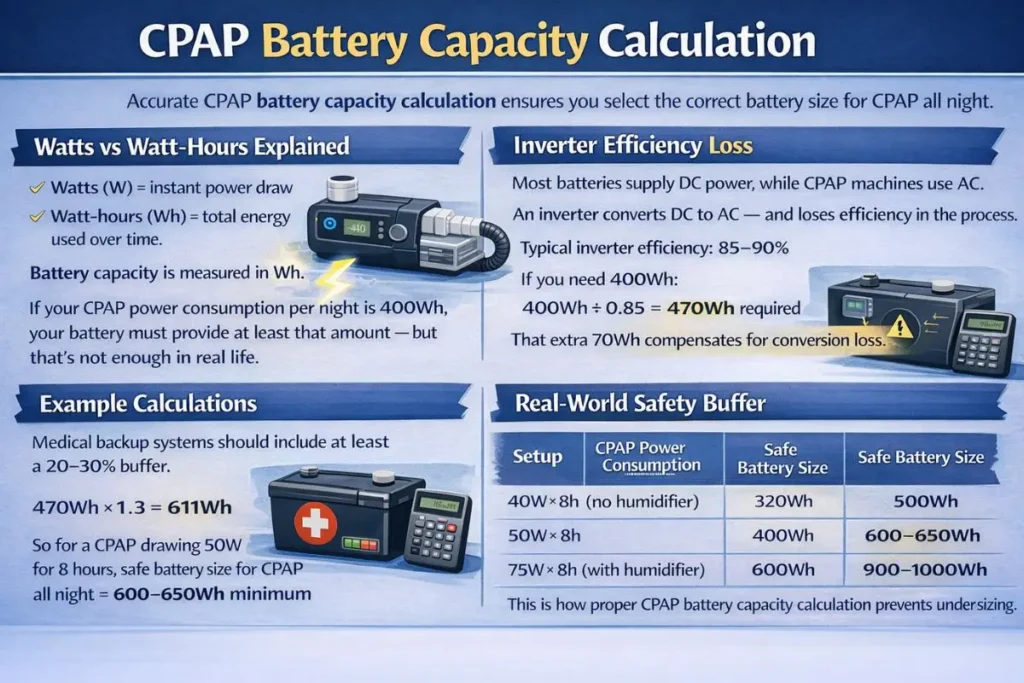
Accurate CPAP battery capacity calculation ensures you select the correct battery size for CPAP all night.
Watts vs Watt-Hours Explained
- Watts (W) = instant power draw
- Watt-hours (Wh) = total energy used over time
Battery capacity is measured in Wh.
If your CPAP power consumption per night is 400Wh, your battery must provide at least that amount — but that’s not enough in real life.
Inverter Efficiency Loss
Most batteries supply DC power, while CPAP machines use AC. An inverter converts DC to AC — and loses efficiency in the process.
Typical inverter efficiency: 85–90%
If you need 400Wh:
400Wh ÷ 0.85 = 470Wh required
That extra 70Wh compensates for conversion loss.
Real-World Safety Buffer
Medical backup systems should include at least a 20–30% buffer.
470Wh × 1.3 = 611Wh
So for a CPAP drawing 50W for 8 hours, safe battery size for CPAP all night = 600–650Wh minimum
Example Calculations
| Setup | CPAP Power Consumption Per Night | Safe Battery Size |
|---|---|---|
| 40W × 8h (no humidifier) | 320Wh | 500Wh |
| 50W × 8h | 400Wh | 600–650Wh |
| 75W × 8h (with humidifier) | 600Wh | 900–1000Wh |
This is how proper CPAP battery capacity calculation prevents under-sizing.
How Long CPAP Runs on Battery
Understanding how long CPAP runs on battery depends on battery capacity and device load.
Single Night Backup
If you own a 500Wh battery:
500Wh × 0.85 inverter efficiency = 425Wh usable
If CPAP consumes 400Wh:
You get approximately 1 full night (with minimal buffer).
Multi-Night Planning
For 2 nights without recharging:
400Wh × 2 = 800Wh
800Wh ÷ 0.85 = 941Wh
Add 30% buffer → 1223Wh
You’d need roughly 1200Wh battery capacity for two safe nights.
Emergency Scenarios
During disasters, recharge options may be limited. Planning for extended outages means increasing battery size for CPAP all night across multiple nights, not just one.
What Affects CPAP Battery Runtime
Several environmental and equipment factors influence how long CPAP runs on battery.
Temperature
Cold weather reduces lithium battery efficiency by up to 20%. Outdoor camping scenarios require larger capacity planning.
Humidifier
Heated humidification is the largest energy drain. Disabling it can double runtime.
Tubing Heat
Heated tubing adds additional wattage demand — especially in cold rooms.
Device Age
Older CPAP machines may draw more power due to motor wear. Always verify your actual CPAP power consumption per night using a watt meter.
Best Battery Backup for CPAP Safety
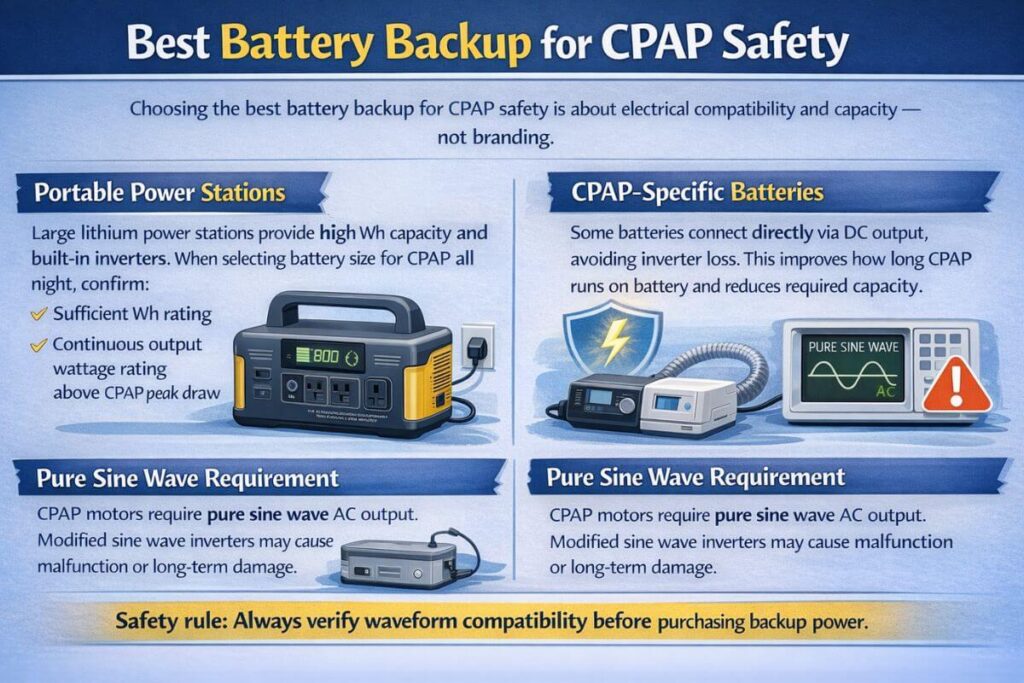
Choosing the best battery backup for CPAP safety is about electrical compatibility and capacity — not branding.
Portable Power Stations
Large lithium power stations provide high Wh capacity and built-in inverters. When selecting battery size for CPAP all night, confirm:
- Sufficient Wh rating
- Continuous output wattage rating above CPAP peak draw
CPAP-Specific Batteries
Some batteries connect directly via DC output, avoiding inverter loss. This improves how long CPAP runs on battery and reduces required capacity.
Pure Sine Wave Requirement
CPAP motors require pure sine wave AC output. Modified sine wave inverters may cause malfunction or long-term damage.
Safety rule: Always verify waveform compatibility before purchasing backup power.
Common Mistakes When Choosing CPAP Battery
Selecting incorrect battery size for CPAP all night can result in therapy failure.
Buying Too Small
Many users calculate only watts × hours and ignore inverter loss and buffer. This leads to shutdown before morning.
Ignoring Inverter Loss
Forgetting 10–15% efficiency loss results in inaccurate CPAP battery capacity calculation.
Trusting Manufacturer Runtime Claims
Generic “10-hour runtime” labels assume ideal lab conditions. Real-world CPAP power consumption per night varies widely.
Safety Planning Before a Power Outage
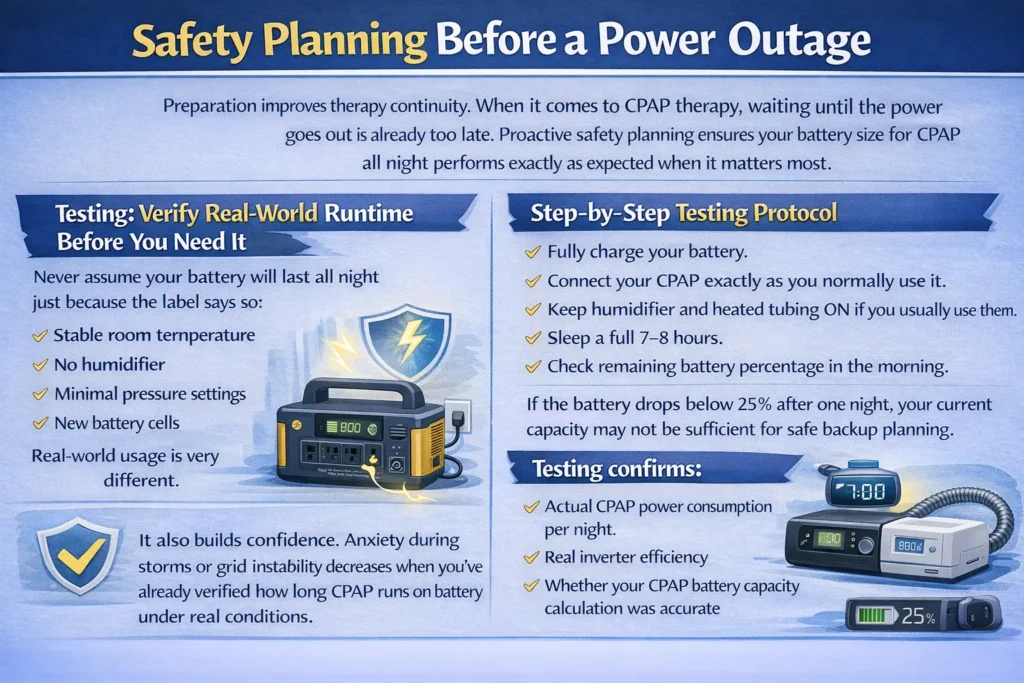
Preparation improves therapy continuity. When it comes to CPAP therapy, waiting until the power goes out is already too late. Proactive safety planning ensures your battery size for CPAP all night performs exactly as expected when it matters most.
Backup power is not something you “hope” works — it’s something you verify, test, and maintain like essential medical equipment.
Testing: Verify Real-World
Runtime Before You Need It
Never assume your battery will last all night just because the label says so.
Manufacturer runtime claims are typically calculated under ideal lab conditions:
- Stable room temperature
- No humidifier
- Minimal pressure settings
- New battery cells
Real-world usage is very different.
Step-by-Step Testing Protocol
- Fully charge your battery.
- Connect your CPAP exactly as you normally use it.
- Keep humidifier and heated tubing ON if you usually use them.
- Sleep a full 7–8 hours.
- Check remaining battery percentage in the morning.
If the battery drops below 25% after one night, your current capacity may not be sufficient for safe backup planning.
Testing confirms:
- Actual CPAP power consumption per night
- Real inverter efficiency
- Whether your CPAP battery capacity calculation was accurate
It also builds confidence. Anxiety during storms or grid instability decreases when you’ve already verified how long CPAP runs on battery under real conditions.
Placement: Protect Both the Battery and Your Safety
Where you place your battery directly impacts performance, lifespan, and safety.
Ventilation Matters
Lithium batteries generate mild heat during discharge and charging. Always:
- Keep the battery on a hard, flat surface
- Avoid covering it with fabric
- Leave airflow space around vents
Never place battery units:
- Under blankets
- Inside closed drawers
- Against heating vents
Proper ventilation prevents overheating and extends battery health.
Avoid Temperature Extremes
Battery chemistry is highly sensitive to temperature.
- Below 32°F (0°C): Capacity can drop 15–25%
- Above 95°F (35°C): Long-term cell degradation increases
If you rely on your battery size for CPAP all night during winter storms or summer heat waves, indoor climate control becomes part of safety planning.
Cold batteries discharge faster.
Hot batteries age faster.
Neither scenario is ideal during a medical event.
Charging Habits: Extend Battery Lifespan Safely
Lithium batteries degrade based on charge cycles and storage behavior. Poor charging habits can reduce effective capacity over time — which changes how long CPAP runs on battery.
Optimal Storage Range
For long-term storage:
- Keep battery between 20% and 80% charge
- Avoid leaving at 100% for months
- Avoid storing completely drained
Fully charge only:
- The day before expected storms
- During high-risk seasons (hurricane, snowstorm periods)
- Before travel or camping trips
Monthly Maintenance Routine
To maintain reliable best battery backup for CPAP safety, follow this simple schedule:
- Once per month: power on battery and check health indicators
- Every 3–4 months: perform a short runtime test
- Every 6 months: do a full overnight simulation
This ensures your backup plan remains accurate as battery cells naturally age.
Seasonal Risk Planning
Power outage probability changes based on location and season.
If you live in:
- Storm-prone coastal areas
- Snow-heavy northern climates
- Rural regions with unstable grid access
You should reassess your CPAP battery capacity calculation annually.
Battery capacity slowly decreases over years. A system that once provided 8 hours may later provide 6–7 hours.
That difference matters at 3 AM.
Emergency Preparedness Checklist
Before storm season, confirm:
✔ Battery fully charged
✔ CPAP tested overnight
✔ Extension cords inspected
✔ Inverter functioning properly
✔ Backup location accessible in the dark
✔ Flashlight nearby
✔ Replacement filters stocked
Emergency readiness is about eliminating variables.
Know Your Limits
Even with correct battery size for CPAP all night, understand limitations:
- Multi-night outages require recharge planning
- Solar charging requires sunlight consistency
- Car charging requires fuel availability
- Public charging stations may be unavailable during disasters
Always calculate realistic expectations — not optimistic ones.
Psychological Preparedness
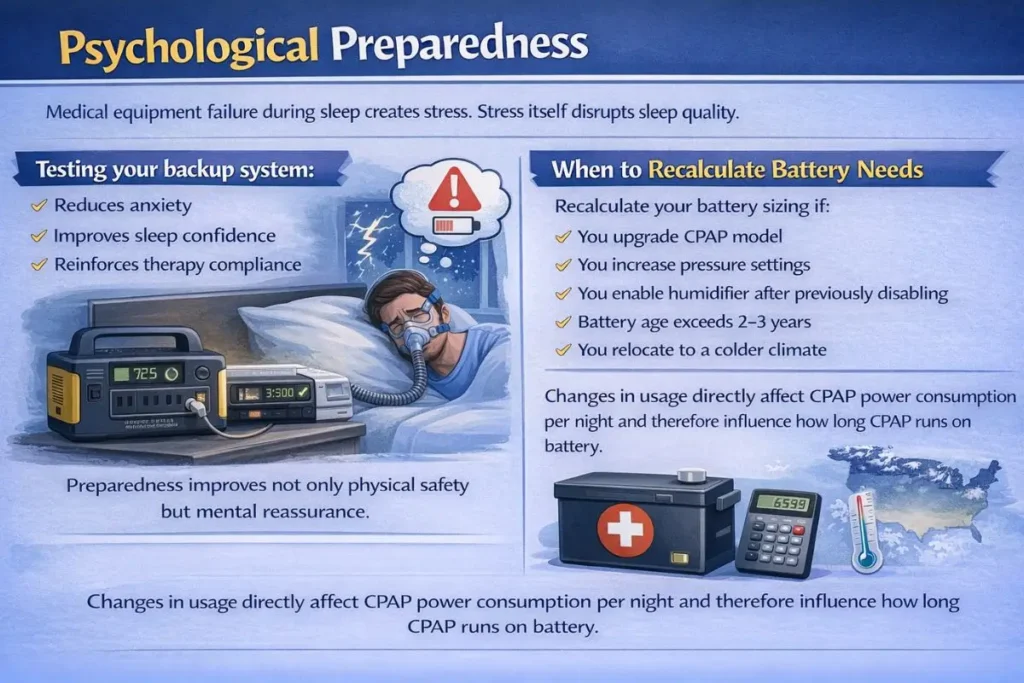
Medical equipment failure during sleep creates stress. Stress itself disrupts sleep quality.
Testing your backup system:
- Reduces anxiety
- Improves sleep confidence
- Reinforces therapy compliance
Preparedness improves not only physical safety but mental reassurance.
When to Recalculate Battery Needs
Recalculate your battery sizing if:
- You upgrade CPAP model
- You increase pressure settings
- You enable humidifier after previously disabling
- Battery age exceeds 2–3 years
- You relocate to a colder climate
Changes in usage directly affect CPAP power consumption per night and therefore influence how long CPAP runs on battery.
Final Safety Reminder
Your CPAP machine is medical equipment — and your backup power system should be treated the same way.
Planning ahead ensures:
- Continuous therapy
- Cardiovascular protection
- Sleep stability
- Peace of mind
Proactive preparation ensures the correct battery size for CPAP all night functions reliably when needed most — not just theoretically, but in real-world conditions.
FAQs
How many Wh are needed for CPAP?
Most users need 500–700Wh for one safe night without humidifier. With heated humidifier, 800–1000Wh may be required. Accurate CPAP battery capacity calculation depends on actual watt draw, inverter efficiency, and safety buffer. Always measure CPAP power consumption per night before selecting battery size for CPAP all night.
Can a small battery run a CPAP overnight?
Small batteries under 300Wh usually cannot run standard CPAP machines for 8 hours unless humidifier is off and wattage is very low. After accounting for inverter loss, usable capacity drops further. This often leads to therapy interruption before morning.
How does humidifier affect battery life?
Heated humidifiers can double CPAP power consumption per night. A machine drawing 40W without humidity may draw 75–90W with heat enabled. That dramatically reduces how long CPAP runs on battery and increases required battery size for CPAP all night.
How often should I replace my CPAP backup battery?
Most lithium battery systems last:
- 500–2000 charge cycles
- 3–7 years depending on usage
However, effective capacity decreases gradually.
Recalculate your CPAP battery capacity calculation every 12–24 months to confirm your battery still meets the required battery size for CPAP all night.
Should I plan for more than one night?
If you live in areas prone to storms or grid instability, multi-night capacity planning is safer. Extend CPAP battery capacity calculation accordingly.
Does turning off the humidifier increase battery runtime significantly?
Yes — dramatically.
Heated humidifiers can double CPAP power consumption per night. Turning off humidity may reduce draw from 70–90W down to 30–50W.
In real terms, this can:
- Reduce required battery size by 30–50%
- Extend how long CPAP runs on battery by several hours
If emergency power is limited, disabling humidifier is often the fastest way to preser
Medical Reliability Requires Electrical Planning
CPAP therapy is a prescribed medical treatment, not a comfort device. Interruptions in therapy can lead to:
- Oxygen desaturation
- Sleep fragmentation
- Increased cardiovascular stress
- Morning headaches and fatigue
Proper planning for the correct battery size for CPAP all night protects more than convenience — it protects physiological stability during sleep.
From a safety standpoint, your backup system should be treated as:
- A medical contingency plan
- A verified electrical solution
- A maintained emergency resource
Accurate CPAP battery capacity calculation, real-world runtime testing, and understanding how long CPAP runs on battery are not optional steps — they are responsible therapy management practices.
Prepared users sleep confidently. Unprepared users gamble on assumptions.
Electrical reliability is part of therapy compliance.
related tags:
#cpapbackuppower #cpapbatterybackup #cpappoweroutage #cpappowersafety #portablepowerstationcpap